Keystone
by CloudVoro
Bakery · Batch traceability

Bakery traceability software for wholesale and craft bakeries.
Flour lot to finished loaf to customer, in one chain.

A bakery's traceability problem is speed and volume: dozens of SKUs, daily production runs, short shelf life, and an allergen list that touches almost every line. When a flour recall or an undeclared-allergen alert lands, you have hours to name every affected bake and every customer who received it. Keystone holds that chain as one connected record, supplier delivery → mix/batch → dispatch line → customer, so the answer takes 30 seconds, not a night in the office.

  • Backward trace: any dispatched product → batch → flour, seed and improver lots → suppliers
  • Forward trace: any ingredient delivery → every bake that used it → every customer, with quantities
  • Allergen-critical records: every batch carries its recipe version and ingredient lot list
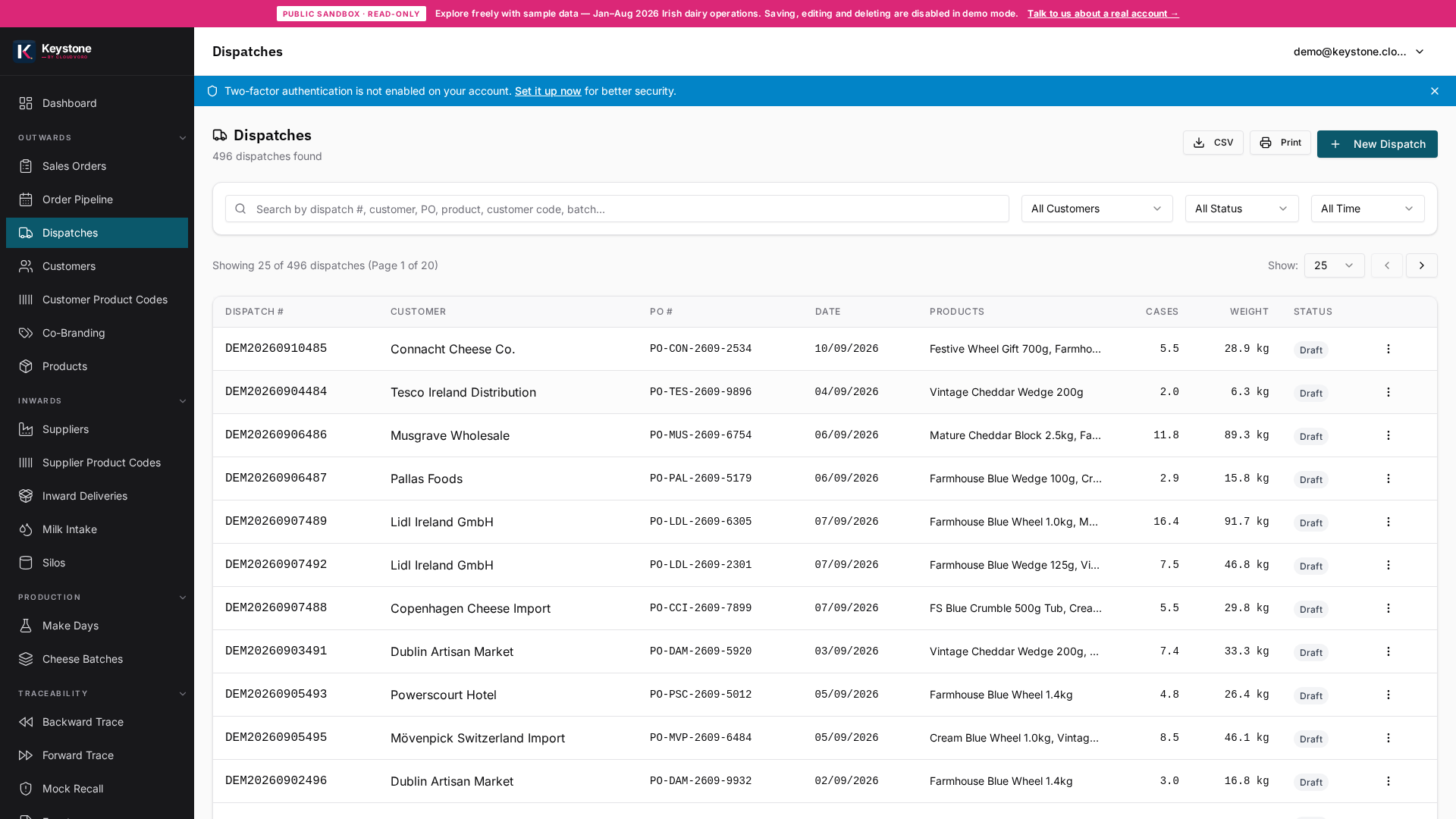
  • Daily-dispatch friendly: batch codes flow to dispatch notes and labels without re-keying
The bakery reality

Daily production breaks weekly spreadsheets.

Most traceability spreadsheets were designed around weekly batches. A bakery produces daily, sometimes twice daily, so the records multiply seven times faster, the re-keying errors compound, and the person maintaining the sheet becomes the single point of failure. Flour alerts make it concrete: when a mill notifies you about a lot, the question is which mixes used that lot across the last N days, and which shops, wholesalers and retailers received those bakes. In Keystone the flour delivery is a first-class record; every mix that drew from it is linked automatically, and the forward trace to customers is one click.

Built for bakery workflows

The edge cases bakeries actually hit.

Multi-ingredient mixes
A single batch can consume a dozen ingredient lots, flour, yeast, seeds, improver, inclusions. Each keeps its identity in the chain for backward trace.
Allergen-aware batches
Every batch carries its recipe version with the ingredient lot list behind it, the evidence base for allergen declarations and undeclared-allergen investigations (the most common category of food recall).
Short shelf life, fast dispatch
Batch codes print on dispatch notes and labels the same morning. No transcription step between the bakehouse and the van.
Wholesale + retail + own shop
Wholesale customers, retail multiples with own-label codes, and direct shop sales all record against the same batch, so the mass balance closes.
Rework and day-2 product
Yesterday's unsold bread into today's breadcrumb line? The rework link keeps the chain intact, the point where bakery mass balances usually die.
Audit posture

SALSA, BRCGS or retailer audit, same evidence, ready.

Whether your customers ask for SALSA (common for craft and regional bakeries) or BRCGS (the multiples' default for own-label), the traceability evidence is the same shape: lot-level records in both directions, a timed annual test, and a mass balance that closes. Keystone renders the chain and the quantities from live records, so the traceability exercise becomes a documentation task instead of a reconstruction project. Keystone is built with an Irish farmhouse producer as founding partner, the batch model applies to any batch-based food production, and bakery workflows (daily makes, multi-ingredient mixes, allergen-led recalls) map directly onto it.

FAQ

Questions buyers actually ask.

Does Keystone handle daily production volumes?
Yes, batches are lightweight to create and can be templated from recipes, so a daily make-plan takes minutes to record. The chain builds itself from the records as you receive, produce and dispatch.
Can it track allergens per batch?
Every batch carries its recipe version and the actual ingredient lots consumed. That gives you the evidence trail behind every allergen declaration, and the affected-batch list in minutes if a supplier reports an undeclared allergen.
We sell through our own shops as well as wholesale, does that break traceability?
No. Direct sales record against batches like any dispatch, so forward trace and mass balance still close. One-step-forward under EU law applies to business customers; your own shop sales are captured as quantities.
Is Keystone SALSA or BRCGS approved?
No certification body approves software, they audit producers. Keystone is designed to support SALSA and BRCGS traceability evidence: lot-level chain both directions, timed tests, immutable audit log, signed exports.
How long to go live?
Pilots scoped to go live in 30 days. Standard licence €790/month, all modules; implementation from €4,950 fixed-fee including 12 months of historical data.

Ready to see if Keystone fits your floor?

20-minute discovery call. No sales pitch. Written scope within 48 hours if we fit, referral to someone better if we don't.

Talk to us
Compliance & trust

How we keep your
data and your audits safe.

Enterprise-grade controls as standard, encryption, MFA for every user, tenant isolation and immutable audit trails, on EU cloud or your own servers. Privacy queries go to privacy@cloudvoro.com. Sub-processor list at /legal/sub-processors. Full security posture at /site/security.

Live
Hosted in EU / Ireland, or on-premise
Customer data resides on AWS Ireland (eu-west-1) and never leaves the EU. Local on-premise deployment available where policy requires it.
Live
GDPR · Privacy Contact named
Internal Data Protection Lead handles subject access requests. Owner is ADPO Ireland member.
Live
MFA for every user
TOTP multi-factor authentication across all roles, with rate limiting, brute-force lockout and reCAPTCHA bot protection on public forms.
Live
ISO 27001 · aligned controls
Security controls mapped to the ISO/IEC 27001:2022 Annex A framework, access management, encryption, logging, incident response.
Live
NIS2 · supporting evidence
Tenant isolation, MFA and immutable audit trails give customers in NIS2 scope direct supporting evidence for their obligations.
Live
Encryption · at rest & in transit
TLS 1.3 in transit, industry-standard symmetric ciphers at rest, KMS-managed keys.