Recall management software for food producers.
Scope it in seconds. Manage it with evidence.
A real recall is two problems at once: scoping (which lots, which customers, how much) and managing (decisions, notifications, documentation, follow-through, all under Article 19 obligations and a ticking clock). Most software only helps with the first. Keystone does both: the 30-second chain trace scopes the event, and the Traceability Events module manages it, status workflow, audit trail, customer communication drafts, and a single exportable response pack for the FSAI, your retailer or your certifier.
- Scope in seconds: affected batches, dispatches, customers and quantities from one starting point
- Event workflow: draft → under review → closed, every status change logged with who/when/why
- Customer communication drafts generated per affected customer
- One-click Response Pack PDF: summary, affected chain, notes, status history, draft notices
Real screens, from our Public Sandbox.
Every screenshot below is captured from the Public Sandbox demo tenant with sample Irish dairy data. No mockups, no client data, no NDAs.
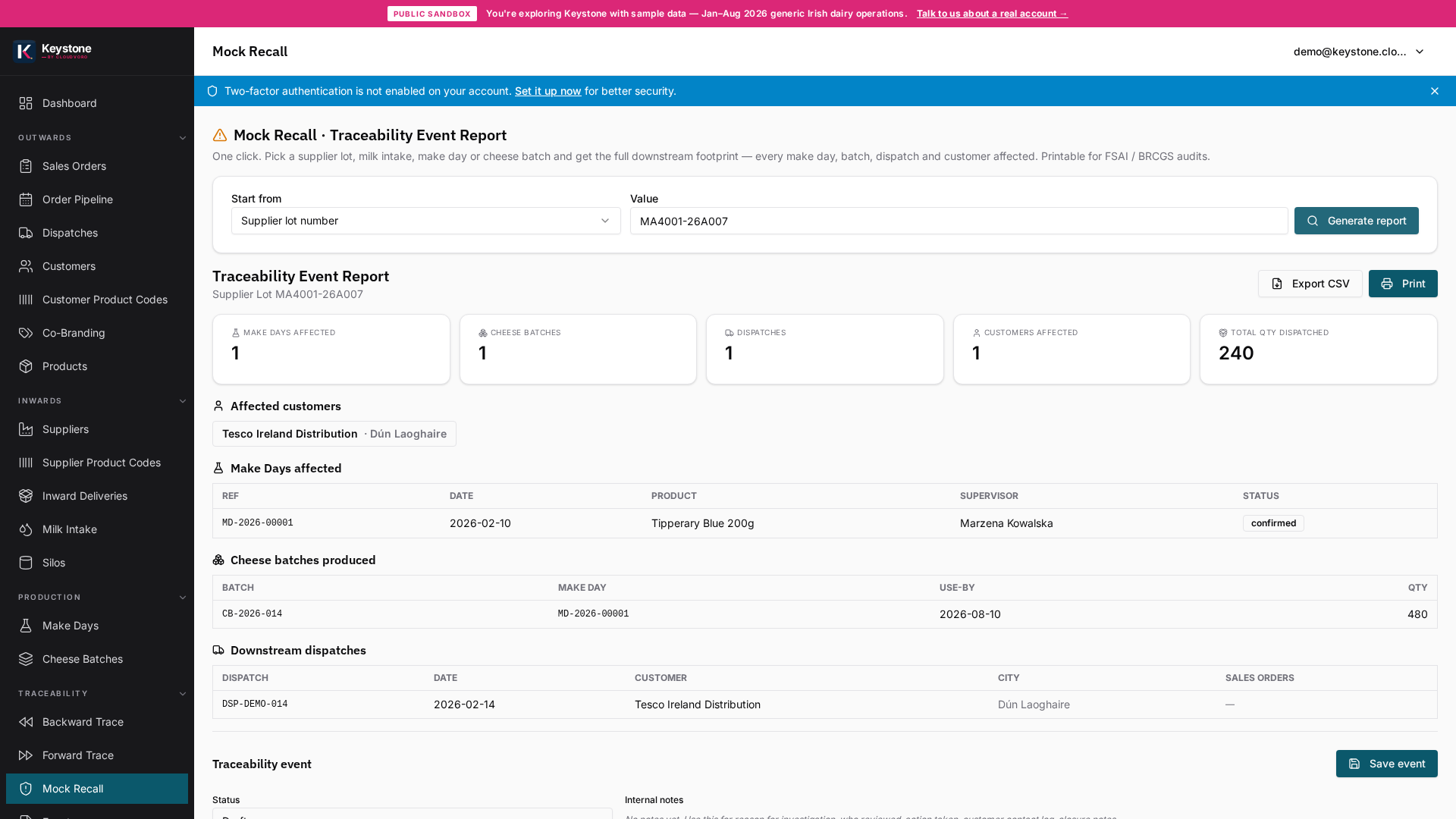
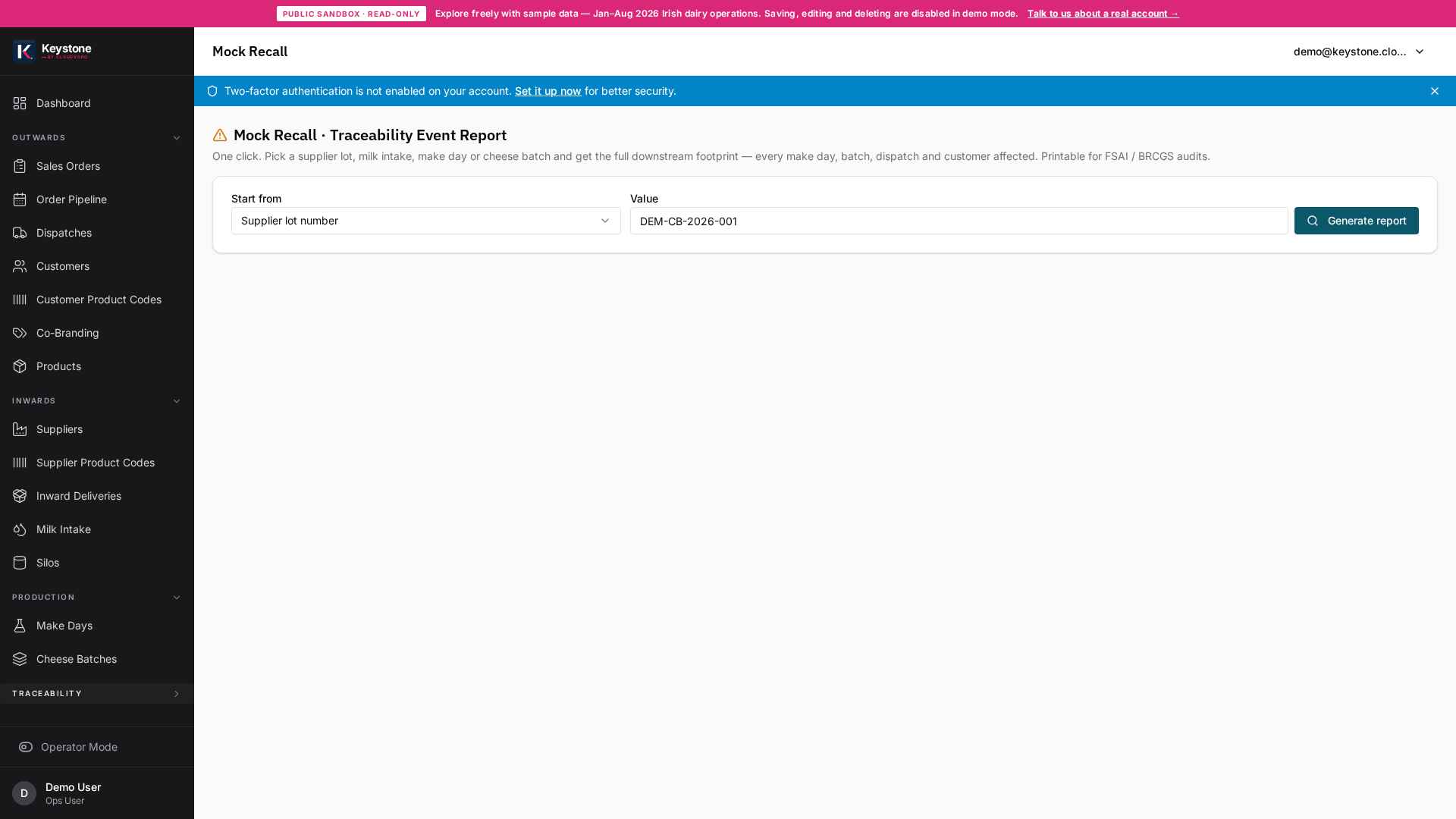
Scoping decides the size of your bad week.
When a supplier alert or a positive test lands, the scope question, exactly which lots and customers are affected, determines everything downstream: how many phone calls, how much product destroyed, how public the event becomes. Imprecise records force a wide scope 'to be safe', which multiplies cost. Keystone's trace starts from any point (a supplier lot, a batch, a dispatch) and returns the full affected chain with quantities in under 30 seconds, so your scope is exactly right, and defensible, from the first phone call. Article 19 of EU food safety regulations requires notifying the competent authority without delay; walking in with a precise, documented scope changes that conversation entirely.
Managing the event, the part spreadsheets never covered.
The same machinery runs your mock recalls.
Because scoping and event management are the same tools in rehearsal and in reality, your BRCGS-required mock recalls (§3.11) stop being a parallel paperwork exercise: run the trace, open an event, walk the decision chain, export the pack, timed, documented, done. Producers who drill quarterly with the real machinery are the ones for whom the real event, if it ever comes, is a bad day instead of an existential one. Our free step-by-step mock recall guide covers the full procedure.
Related pages on this stack.
Questions buyers actually ask.
Does Keystone notify the FSAI or customers automatically?
What exactly is in the Response Pack PDF?
Can we re-open and update an event as it develops?
Does this satisfy BRCGS incident-management requirements?
How is this different from your mock recall feature?
Ready to see if Keystone fits your floor?
20-minute discovery call. No sales pitch. Written scope within 48 hours if we fit, referral to someone better if we don't.
Talk to us