You don't have a dashboard problem.
You have a spreadsheet problem.
Excel works. Until it doesn't. Here's a side-by-side of what changes when you move batch traceability, dispatch and COAs off spreadsheets and into Keystone, using the exact metrics our founding partner measured before and after.
- Audit-ready: traceability lookup under 30 seconds (was: 2+ hours)
- Handover risk: zero. The system holds the knowledge (was: one person)
- BRCGS mock-recall: 90 seconds (was: half a day)
- Dispatch-note rejection rate: zero. Retailer-formatted (was: ~5–8%)
Real screens, from our Public Sandbox.
Every screenshot below is captured from the Public Sandbox demo tenant with sample Irish dairy data. No mockups, no client data, no NDAs.
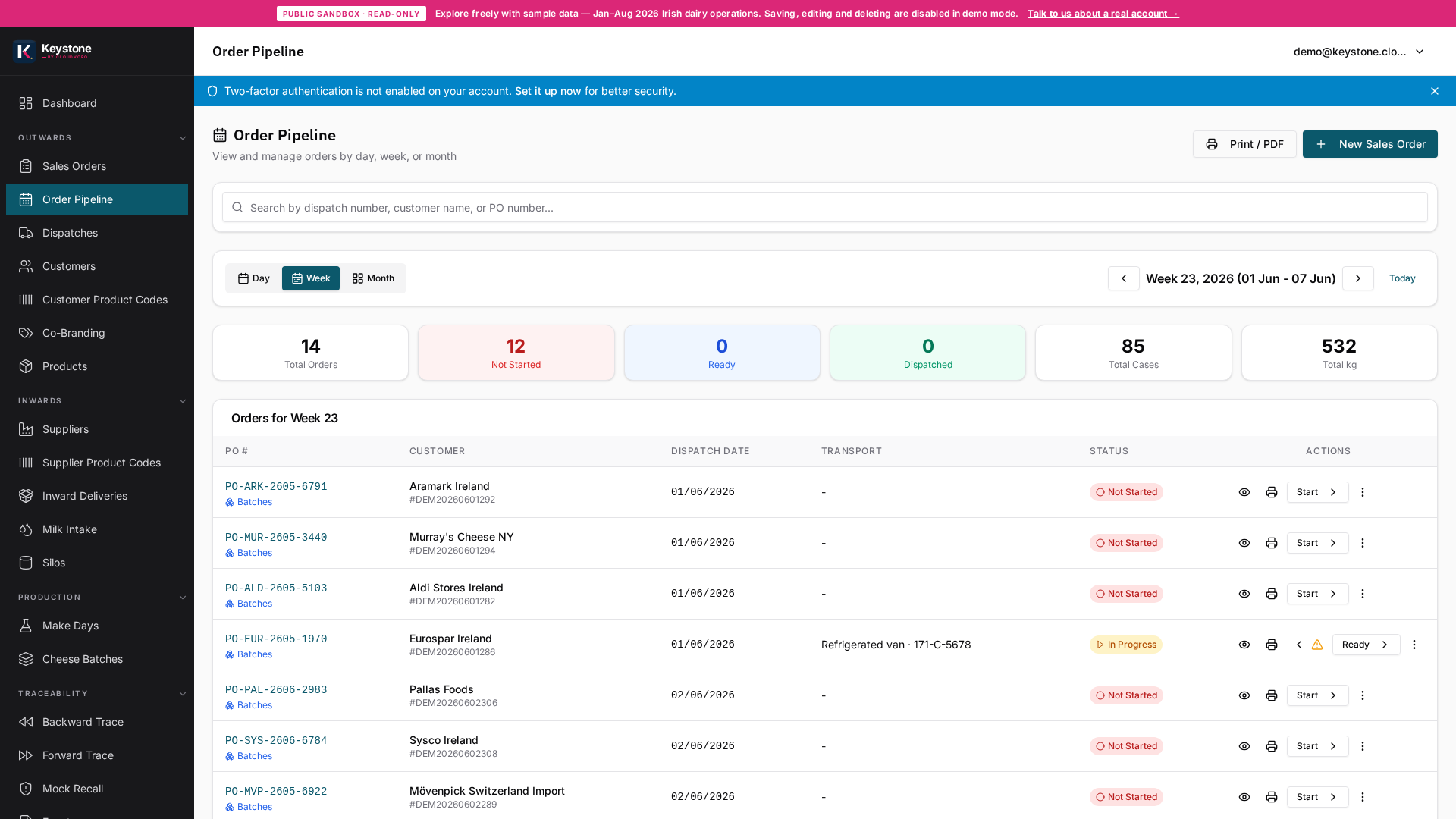
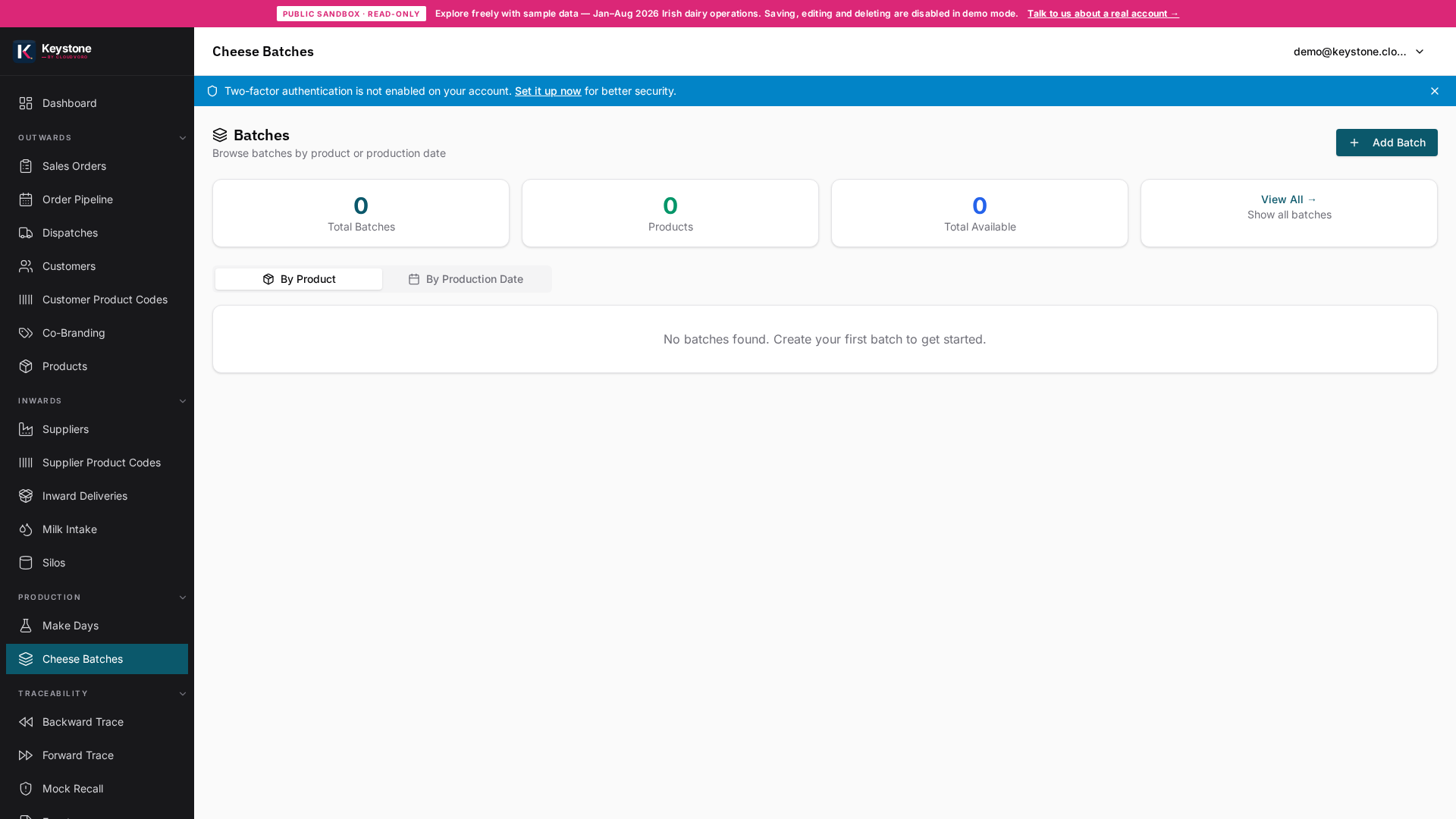
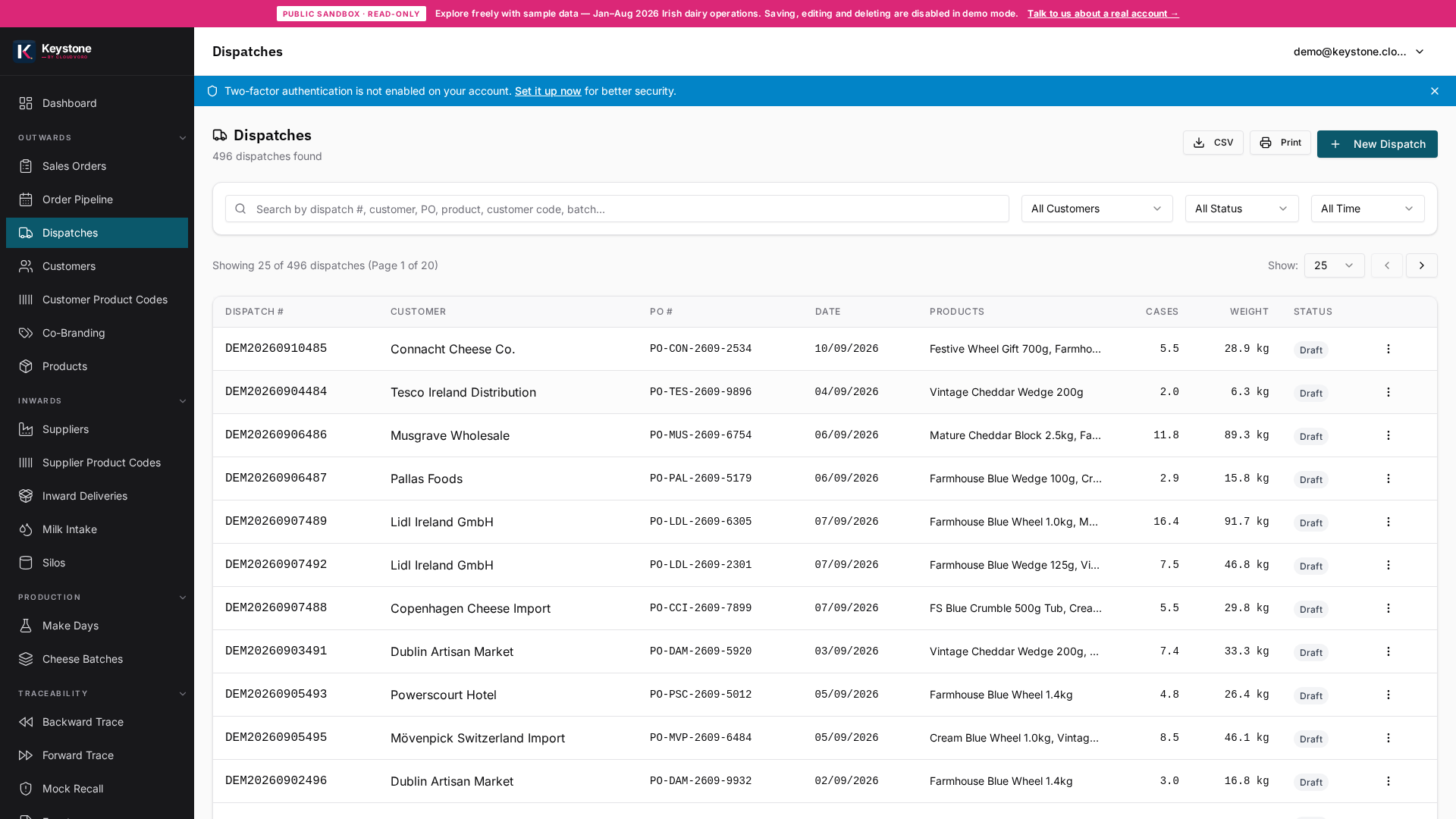
Spreadsheets are great. Until the FSAI calls.
Most Irish artisan food producers run their entire operation on a beautifully crafted Excel workbook, usually built by one person who knows where every formula lives. It's clever. It's free. It works. The problem isn't the spreadsheet itself, it's everything that depends on it: traceability, audit-readiness, retailer compliance, succession risk. The moment that one person is on holiday and an SFPA inspector walks in, the system breaks down.
What actually changes.
| Capability | Excel | Keystone |
|---|---|---|
| Traceability lookup (full chain) | ✗ 2+ hours, manual | ✓ Under 30 seconds, one query |
| Mock-recall (BRCGS) | ✗ Half a day, error-prone | ✓ 90 seconds, signed PDF |
| Audit log | ✗ None, last-saved version only | ✓ Immutable, who/when/why on every change |
| Handover risk | ✗ High, one person holds the knowledge | ✓ Zero, the system holds the workflow |
| Dispatch notes | ✗ Generic Word doc, often rejected | ✓ Retailer-formatted, audit-trail per send |
| COAs per batch | ✗ Manual copy-paste | ✓ Auto-attached to every dispatch |
| Customer SKU mapping | ✗ Lookup tables | ✓ Native, bidirectional, with reverse-lookup |
| Concurrent users | ✗ One at a time, file locks | ✓ Whole team, real-time |
| Backup | ✗ Hope the laptop survives | ✓ Daily encrypted, 30-day point-in-time restore |
| Cost | ✗ Free upfront. Expensive when it fails. | ✓ €790/month standard licence |
We won't pretend everyone needs us.
Excel is still the right answer if you tick all three of these boxes: (a) your business is under roughly €1m in annual revenue, (b) you make essentially one SKU, one cheese, one bake, one cut, with maybe a couple of pack sizes, and (c) you don't supply national retailers (Tesco / SuperValu / Lidl / Aldi / Dunnes / M&S). At that scale a well-built workbook is fine. The threshold flips when any of the following are true: you're losing two hours a week chasing traceability, you're getting dispatch notes rejected by a retailer, a BRCGS audit is on the calendar in the next 12 months, or you're worried about what happens when the one person who knows the spreadsheet is on leave. At that point €790/month buys back the time, the audit confidence and the handover safety.
Related pages on this stack.
Questions buyers actually ask.
Can you import our existing Excel data?
What if I still want to use Excel for some things?
Will my team actually use it?
What happens if you go out of business?
Ready to see if Keystone fits your floor?
20-minute discovery call. No sales pitch. Written scope within 48 hours if we fit, referral to someone better if we don't.
Talk to us