Mock recall in 90 seconds.
Not half a day with three QA managers and a whiteboard.
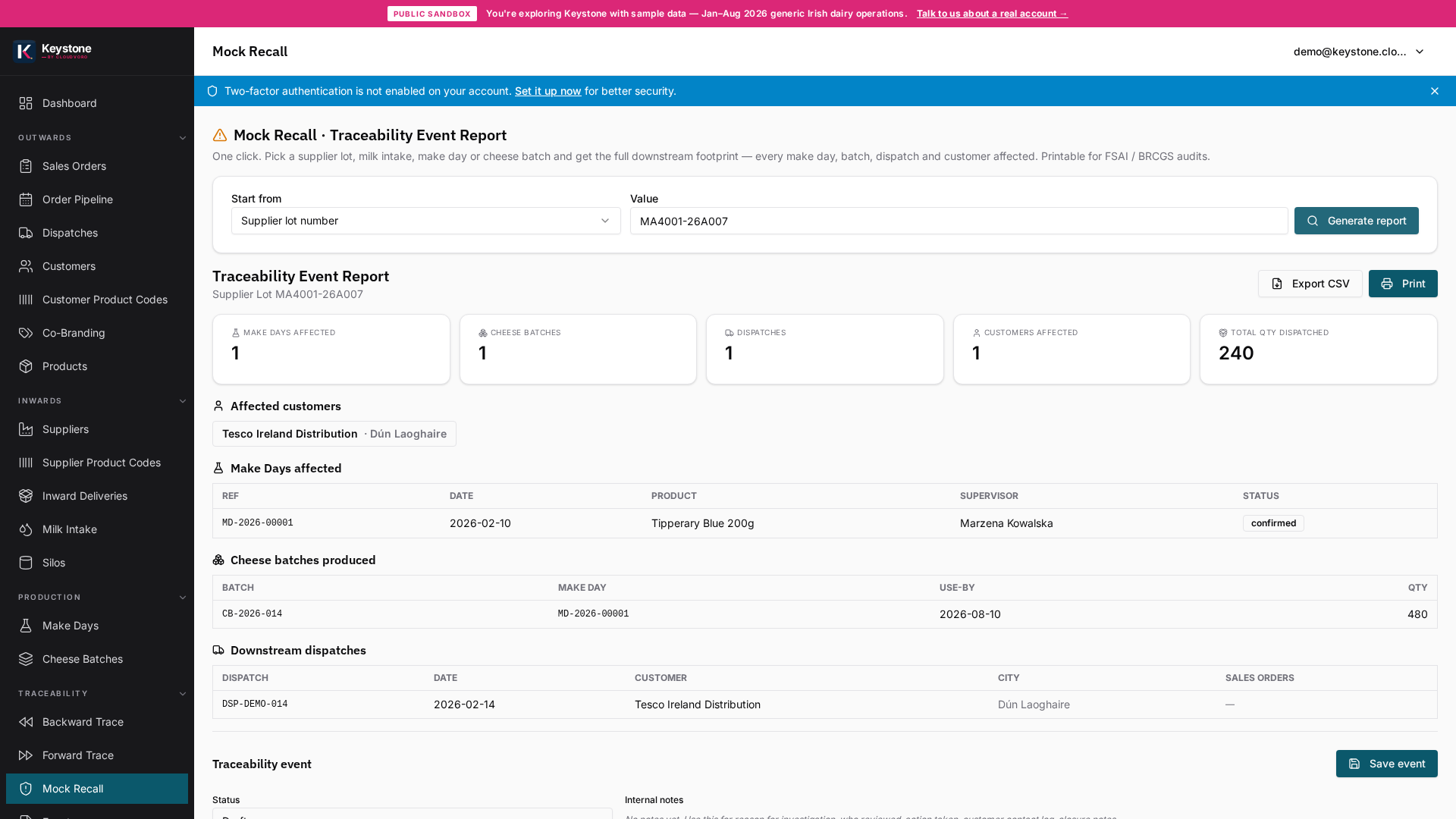
BRCGS requires you to run a mock recall on real production data, end-to-end, and produce a signed traceability report. In Excel, that's half a day and a knot in your stomach. In Keystone, it's 90 seconds and a signed PDF.
- Pick a batch or dispatch, full chain returns in under 30 seconds
- One-click signed PDF for the audit folder
- Includes upstream supplier chain + downstream customer chain
- Audit log of every mock recall run (who, when, which batch)
Real screens, from our Public Sandbox.
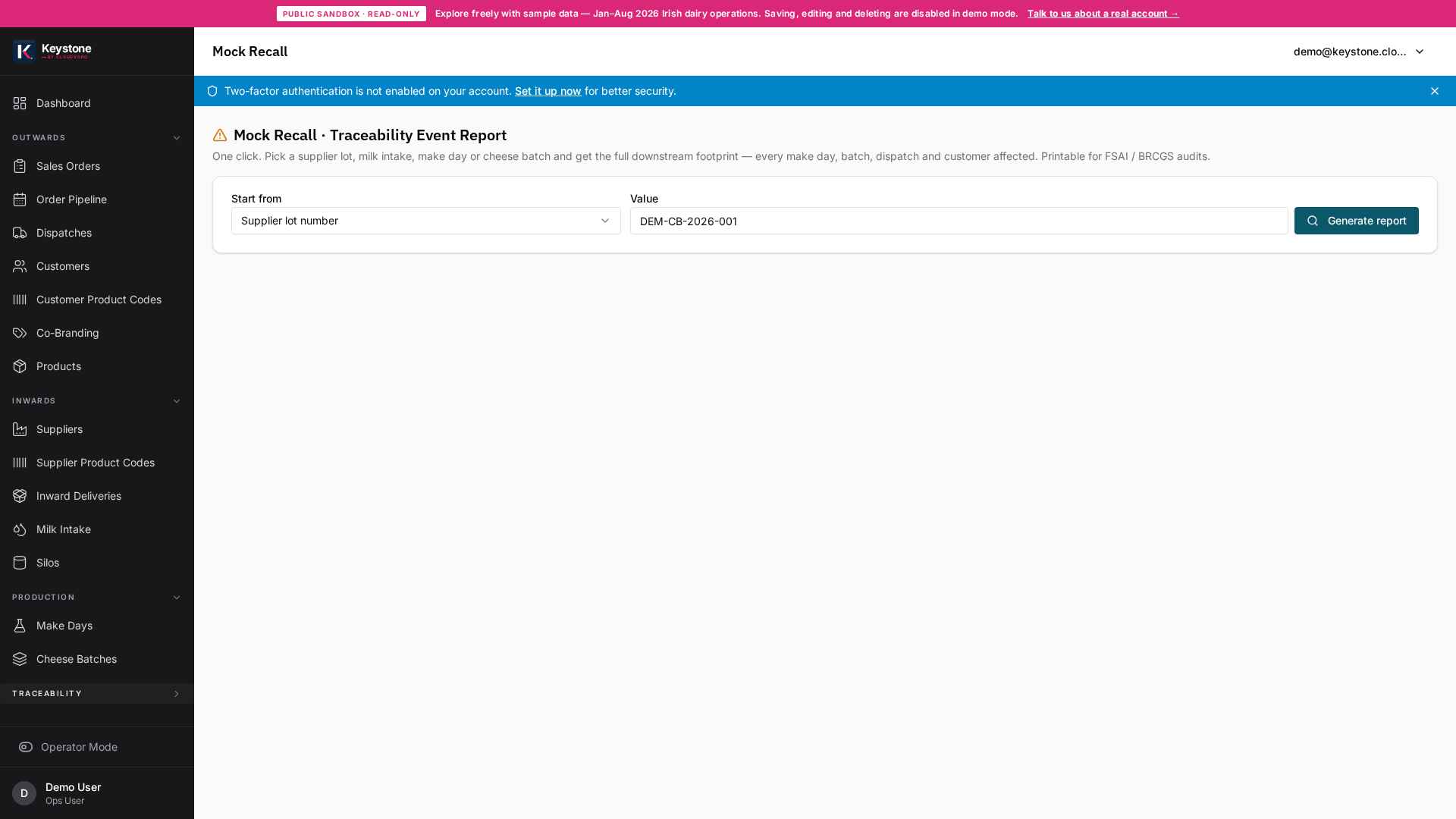
Every screenshot below is captured from the Public Sandbox demo tenant with sample Irish dairy data. No mockups, no client data, no NDAs.
BRCGS auditors don't accept 'we'd be able to find it.'
BRCGS traceability sections (traceability) requires evidence that you can produce a complete chain, upstream and downstream, within a specified time. Most artisan producers can technically do this in Excel; they just can't do it fast enough, with a signed audit trail, on demand. That's where audits get downgraded.
A traceability test you actually want to run.
The trace is 90 seconds. The exercise is everything around it.
A mock recall that satisfies an auditor is more than the trace: someone independent nominates the lot, the clock is logged, the mass balance closes within your stated tolerance, the customer and FSAI notifications are drafted (not sent), and the write-up names what didn't work with corrective actions. Keystone compresses the mechanical middle, the chain, the quantities, the document references, so your QA team spends the exercise on the parts that need judgement: the scenario, the decision chain, the honest findings. Most customers run the whole documented exercise in under 90 minutes; the write-up is the long part. We published our complete step-by-step procedure, including a worked mass balance, as a free guide.
The gaps a 90-second trace exposes early, instead of on audit day.
Related pages on this stack.
Questions buyers actually ask.
Will running mocks cost more on my licence?
Does it generate the BRCGS template document?
Can the SFPA accept the output?
How fast is "90 seconds" in reality?
Ready to see if Keystone fits your floor?
20-minute discovery call. No sales pitch. Written scope within 48 hours if we fit, referral to someone better if we don't.
Talk to us