Cheese production software for batch-based producers.
Built on a make-day, not in a spreadsheet.
From milk intake to make day to ageing to dispatch, the production reality of a cheese house is a different shape from anything a generic ERP imagines. Keystone was written next to a real cheese vat, with the QA Manager watching, the dispatch lead asking awkward questions, and a Tuesday-morning order deadline closing in.
- Recipe & make-process per cheese, with version control
- Ageing windows tracked per batch, with auto-release on completion
- Variable-weight wheels reconciled at unit, case and pallet level
- Live with Cashel Farmhouse Cheesemakers, extensive product range
Real screens, from our Public Sandbox.
Every screenshot below is captured from the Public Sandbox demo tenant with sample Irish dairy data. No mockups, no client data, no NDAs.
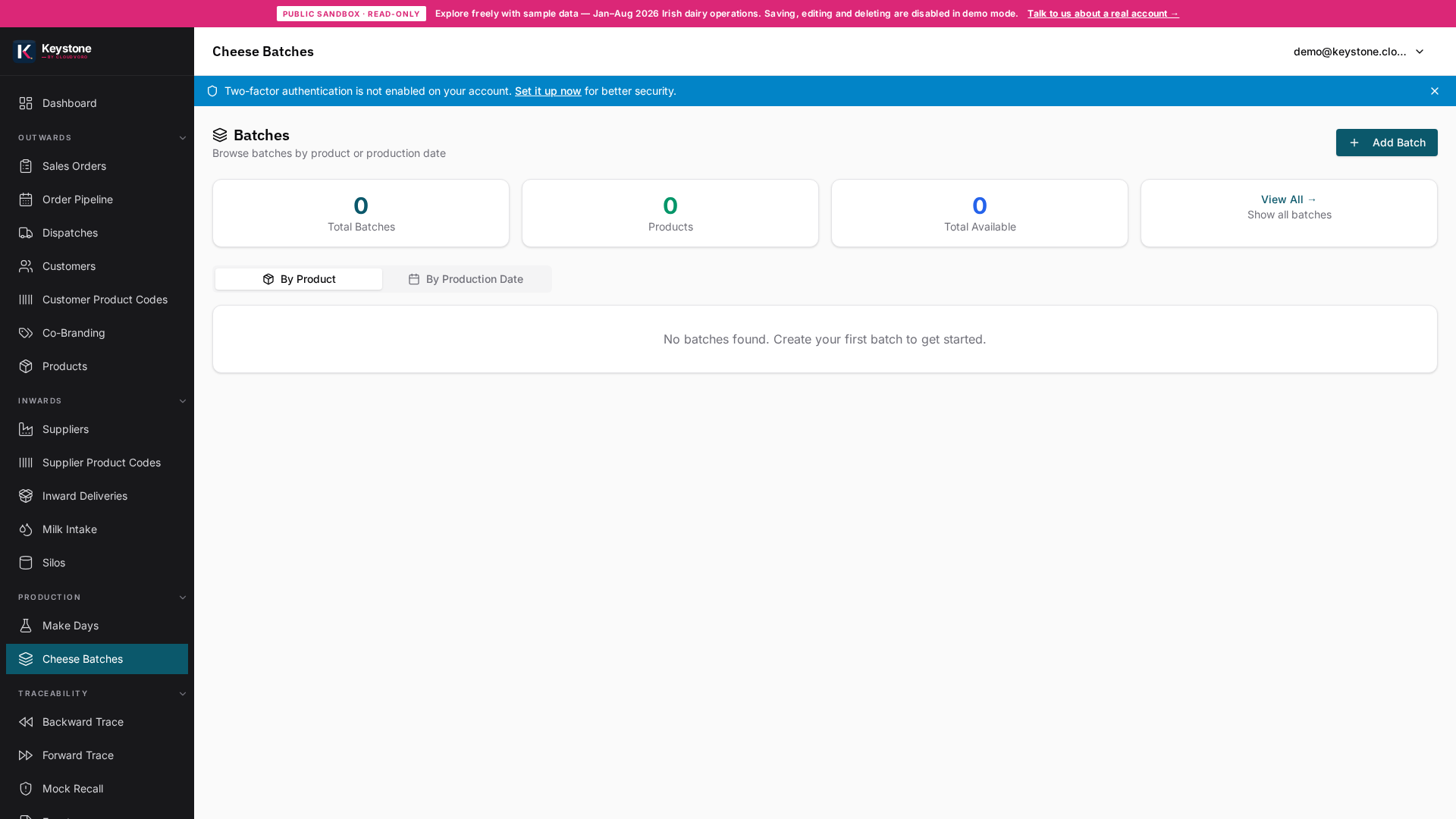
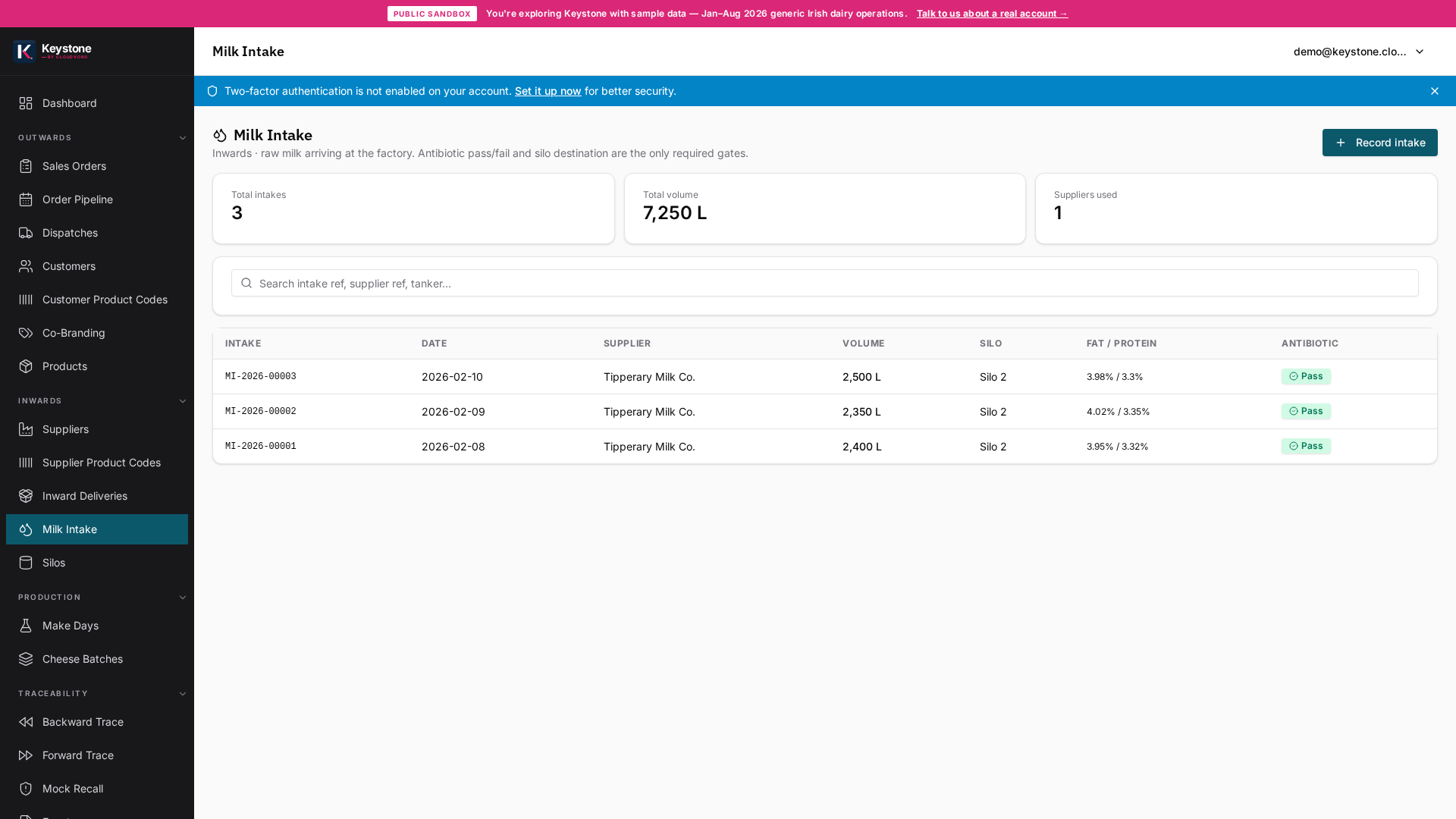
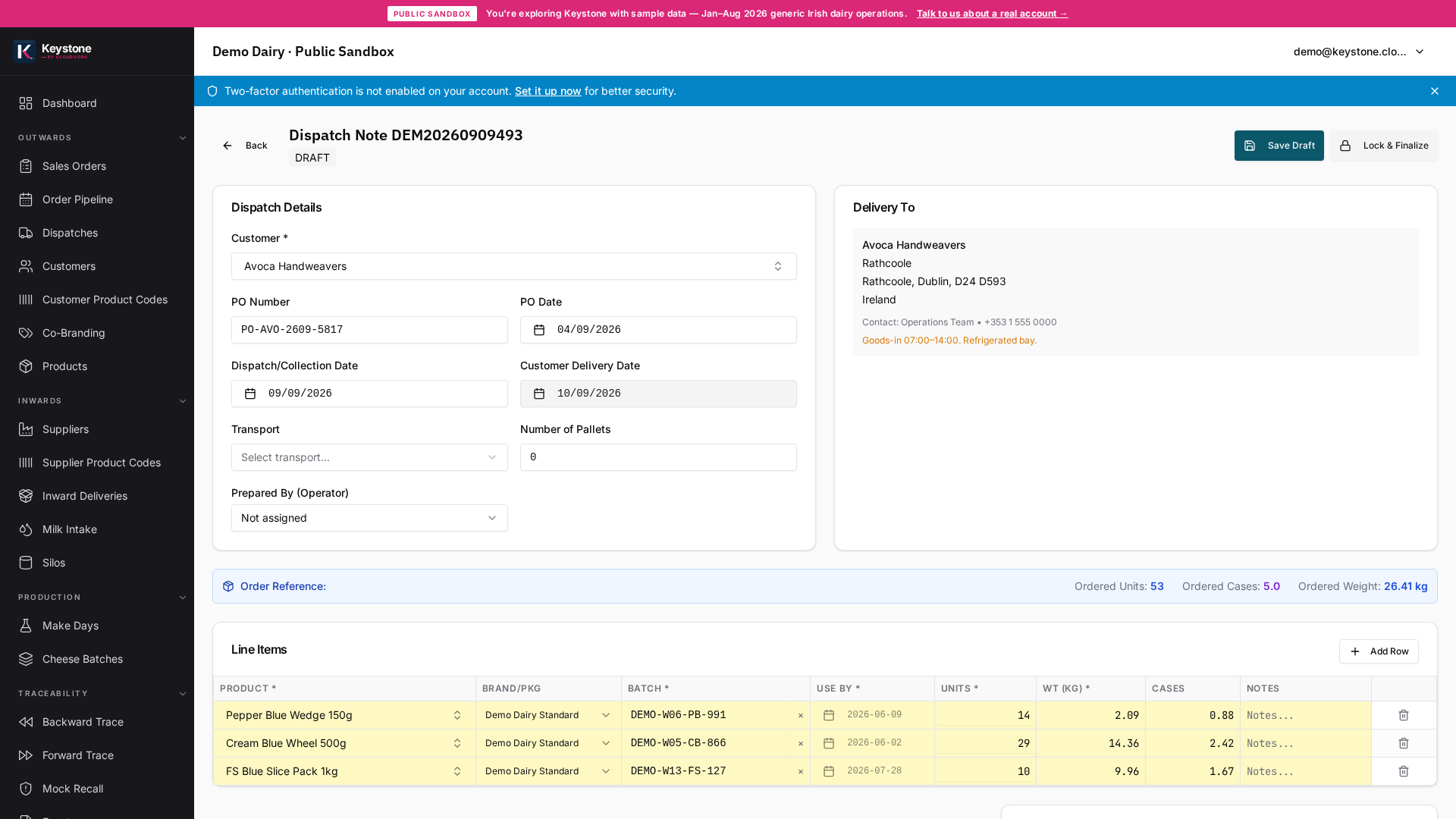
The vat is the source of truth, not Excel.
Every make starts with a recipe, a target yield, a quantity of milk earmarked, a planned start time and a make team. Keystone tracks the make from the moment the milk lands in the vat: salt added, rennet added, cut time, pitch temperature, drain time, salt rate, mould allocation. None of this is optional in a serious cheese audit, and none of this should live in a notebook on top of the vat.
Cheese is not finished when the wheel is wrapped.
A 1.4 kg wheel is rarely a 1.4 kg wheel.
Generic ERPs round to whole units and the variance vanishes into a shrinkage account. Keystone tracks the actual weight of each wheel at unit level, rolls up to the case, rolls up to the pallet, and reconciles back to the dispatch line. The retailer gets the correct dispatched weight; your COA reflects what actually shipped; your accounts package gets a clean invoice without a manual variance entry.
Not an ERP. The production layer beside one.
Keep your accounts package, AccountsIQ, Sage, Xero, QuickBooks. Keep your milk-payments system. Keystone is the production layer between them: make day, batches, ageing, QC, dispatch, COAs, retailer pallet labels, customer SKU mapping and full traceability. Dispatched orders post cleanly back to your accounts package as invoiced sales.
One chain from the tanker to the retailer depot.
Cheese traceability has more hops than almost any other food: farm → tanker → silo → vat → batch → ageing room → grading → cut/pack → dispatch → depot, often with private-label re-codes at the end. Keystone holds that whole chain as one connected record. When a farm reports a residue issue, one click shows every batch its milk touched and every customer those batches reached. When a retailer queries their SKU and a best-before, it resolves to the vat and the make-day record. This is the exercise BRCGS expects inside 4 hours with a closed mass balance, in Keystone the chain renders in under 30 seconds, and the mass balance is computed from the same records.
Solved because a real cheesemaker made us solve them.
Related pages on this stack.
Questions buyers actually ask.
Do you support multi-step processes (e.g. brining, smoking, ageing rooms)?
Can we have separate recipes per customer (own-label variants)?
How does this compare with a cheese-specific ERP?
Will my finance team need retraining?
Can we run this for cow, sheep and goat in one tenant?
Ready to see if Keystone fits your floor?
20-minute discovery call. No sales pitch. Written scope within 48 hours if we fit, referral to someone better if we don't.
Talk to us