Keep your Sage.
Replace the spreadsheets running production.
Sage 50, 200 and X3 are reliable accounting platforms. They are not built for batch traceability, mock-recall workflows, or retailer-specific dispatch templates, and they should not be. Keystone is the production layer that sits next to Sage and feeds clean invoiced sales back. No Sage replacement. No ERP migration. No Mary-in-accounts learning a new ledger.
- Compatible with Sage 50, Sage 200 and Sage X3, Intacct on roadmap
- Invoiced sales publish from Keystone → Sage on dispatch, no double entry
- Your finance team keeps using Sage exactly as they do today
- BRCGS-grade traceability and audit trail Sage was never designed to give you
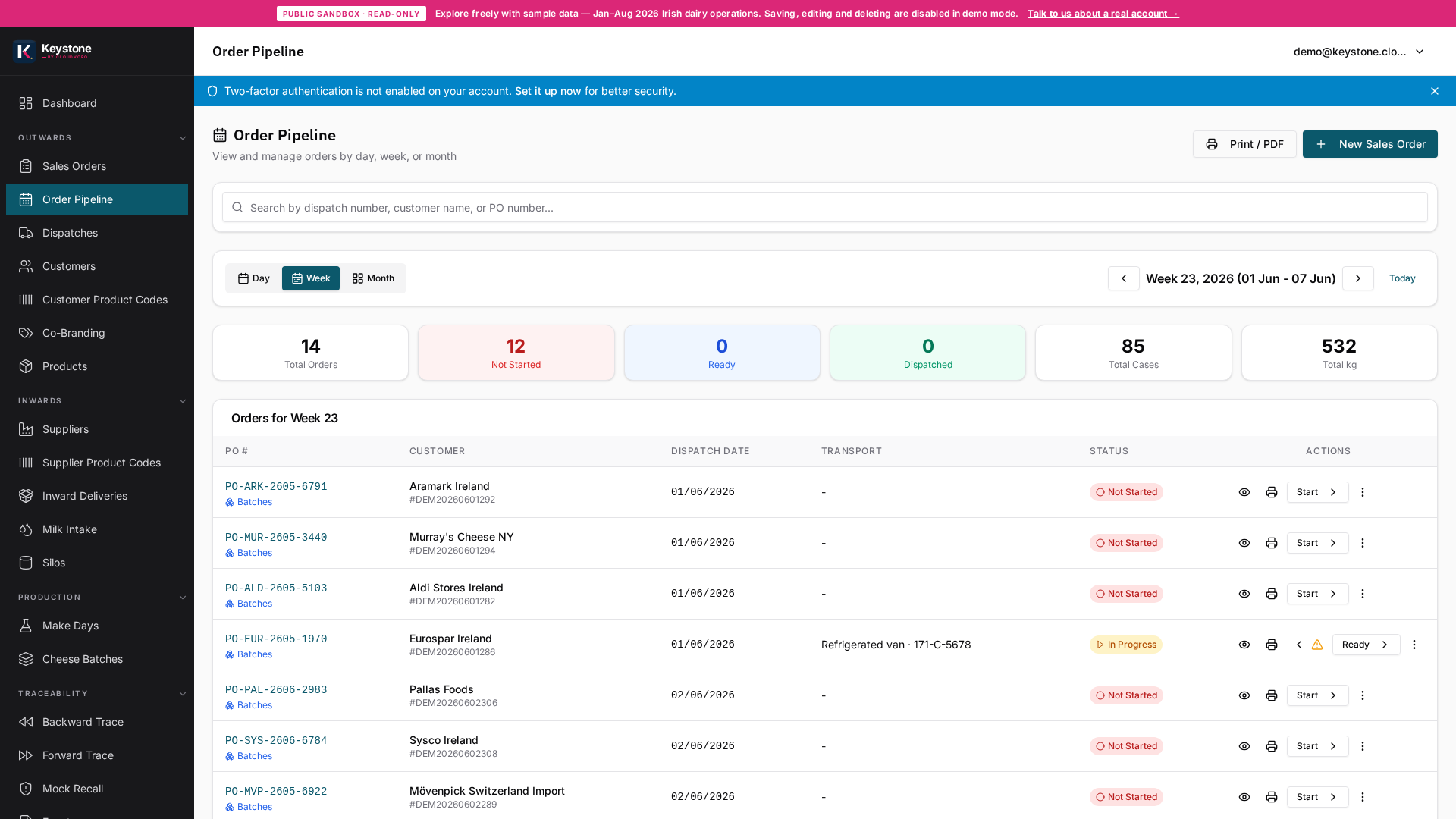
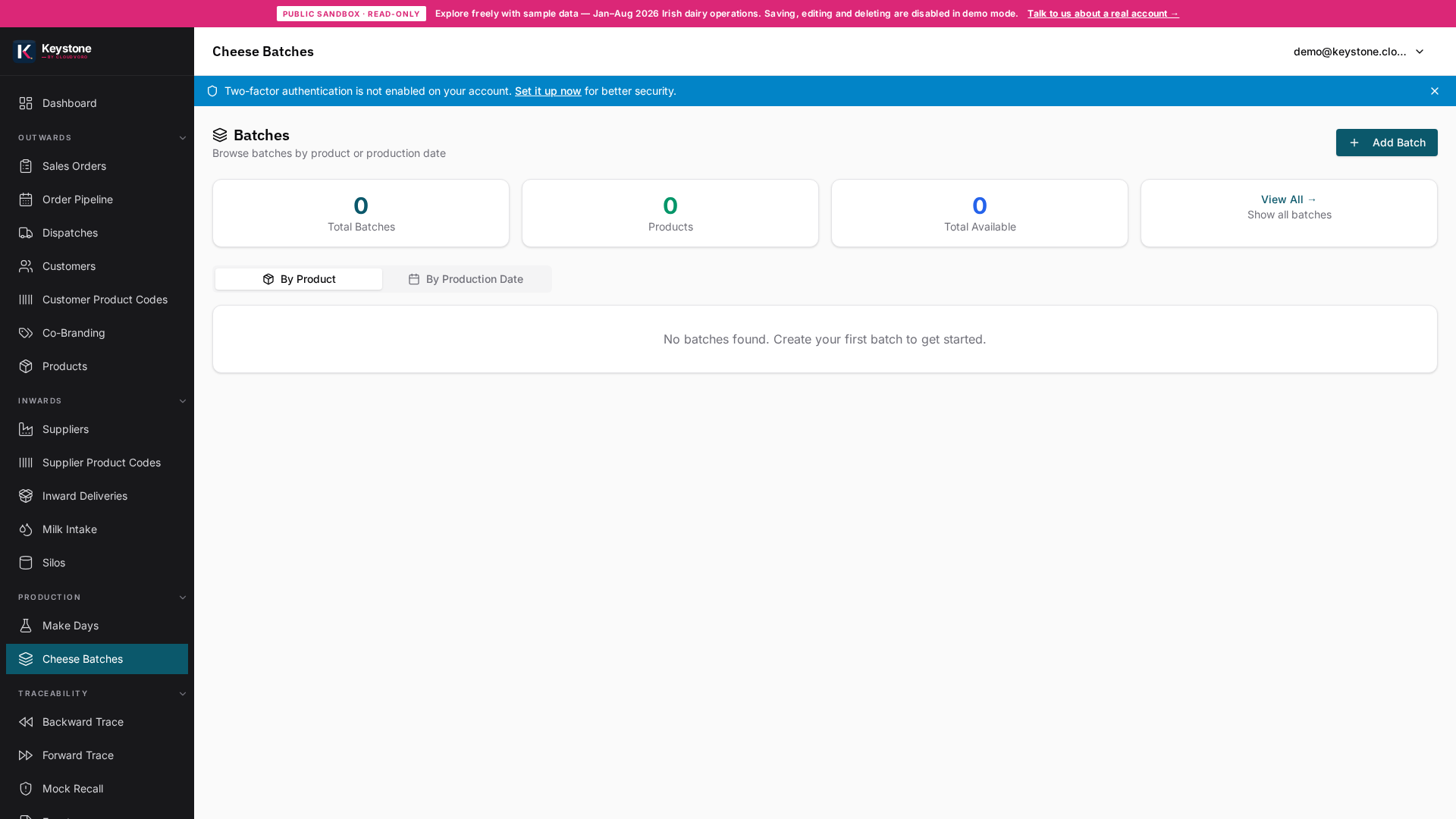
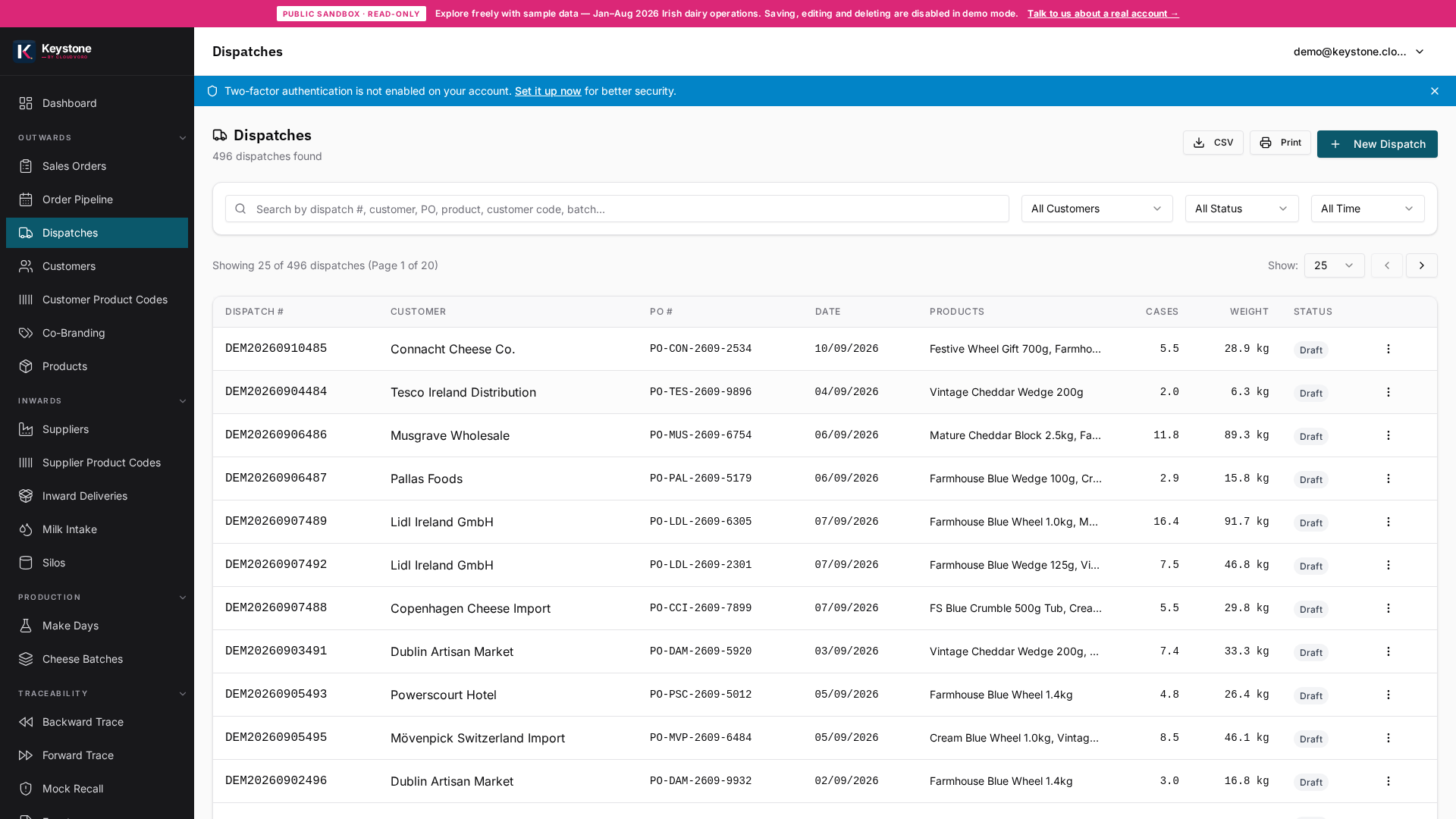
Real screens, from our Public Sandbox.
Every screenshot below is captured from the Public Sandbox demo tenant with sample Irish dairy data. No mockups, no client data, no NDAs.
Finance in Sage. Production in Keystone.
Most small and mid-sized food manufacturers do not need a full ERP replacement project. They need a reliable accounting package, which Sage already is, connected to a production and operations layer that actually matches how the factory works. That is the entire pitch. Sage stays where it is. Keystone takes over the operational reality: orders, planner, batches, QC, dispatch notes, COAs, pallet labels, customer codes, full traceability.
You have already felt this.
If you have spent more than a year trying to make Sage handle batch numbers, you know the pattern: custom fields, third-party traceability add-ons, exports to Excel that get re-imported, audit-log gaps the BRCGS auditor noticed. None of that is a Sage fault, it is a category mismatch. Sage was built to keep the ledger correct. Keystone was built to keep production reality correct.
One direction by default. Clean. Auditable.
Not anti-ERP. Pragmatic-ERP.
A large multi-site producer with plant automation, MES, advanced costing and EDI may genuinely need a full ERP or a Sage X3 + bolt-on stack. For them, Keystone may sit below ERP as a specialist operational layer or serve a single site. For most artisan, family-owned and mid-market producers, the kind already using Sage 50 or 200, running Sage + Keystone side by side is faster, cheaper and lower-risk than any ERP migration.
Related pages on this stack.
Questions buyers actually ask.
Which version of Sage do you support?
Is the Sage integration included in the licence?
Will my finance team need retraining?
Can I do the Sage integration myself?
What happens at year-end?
Is this a Sage replacement?
Ready to see if Keystone fits your floor?
20-minute discovery call. No sales pitch. Written scope within 48 hours if we fit, referral to someone better if we don't.
Talk to us