Every retailer has its own code for your product.
Stop translating between them in your head.
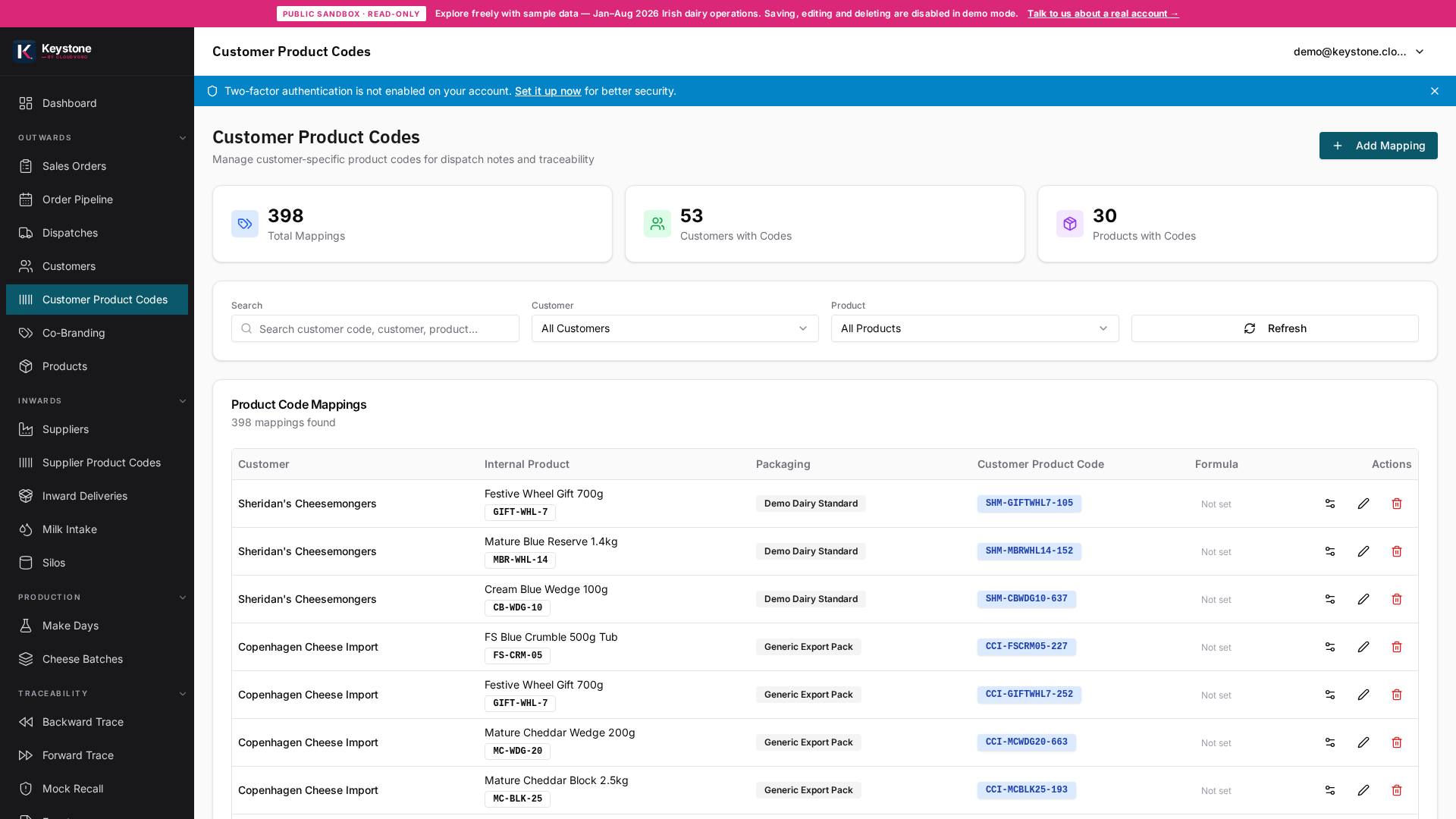
Your internal code for a 1.4 kg blue wheel might be CB-BLUE-1.4. Tesco calls it TES-FBWHL14-742. SuperValu calls it SVAL-CB-14. M&S has its own EAN. Aldi has another one. Multiply that by 40 SKUs and 8 retailers and the translation work becomes a full-time job for one person, usually the same person who runs dispatch. Keystone maps every code automatically. Search either way; the system translates.
- Bidirectional mapping between your internal code and customer codes
- Search by your code OR by any customer code
- EAN-13 / GTIN handling for retailer barcode requirements
- Bulk import from supplier specs or EDI catalogues
Real screens, from our Public Sandbox.
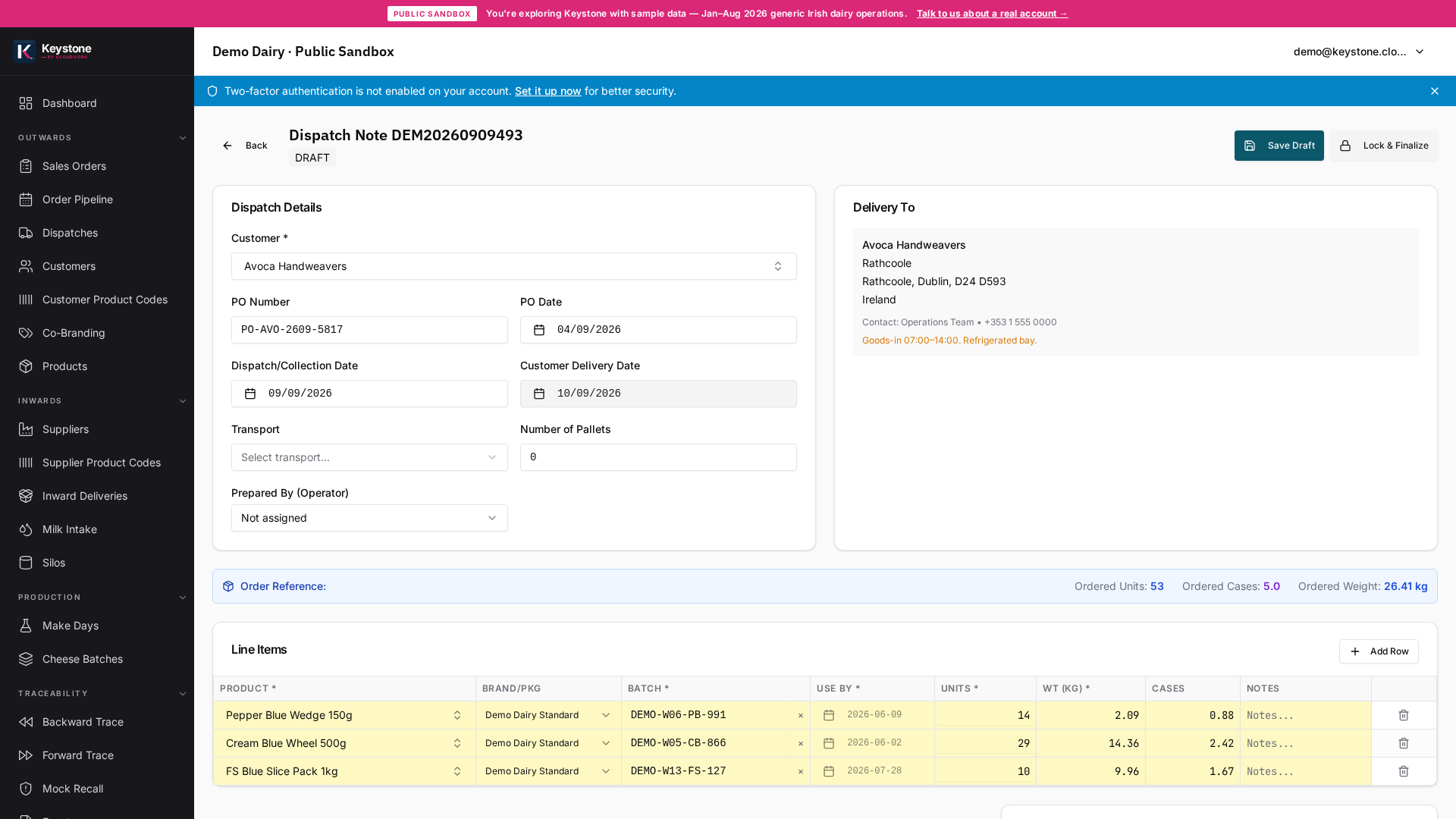
Every screenshot below is captured from the Public Sandbox demo tenant with sample Irish dairy data. No mockups, no client data, no NDAs.
One person becomes a translation service.
If customer SKU translation lives in someone's head, usually the dispatch lead or a long-serving QA team member, you have created an operational risk. They go on holiday, dispatches lurch. They leave, you lose institutional memory. They make a typo, a Tesco pallet gets rejected. None of this is their fault, it is a workflow that should not live in human memory in the first place.
Codes are first-class data, not spreadsheet cells.
Forward trace by customer code, not just your code.
When a retailer complains 3 weeks after dispatch, they will quote their code, not yours. Keystone resolves that to the right batch chain immediately, the same way you would resolve a complaint quoted in your own code. Forward trace works both directions: your internal trace and the retailer-facing trace return the same chain.
Related pages on this stack.
Questions buyers actually ask.
How many customer codes can a single product carry?
Can we import from a Tesco or Lidl supplier spec PDF?
What happens when a retailer changes a code?
Can the same product have different recipes per customer?
Does this work without retailer EDI?
Ready to see if Keystone fits your floor?
20-minute discovery call. No sales pitch. Written scope within 48 hours if we fit, referral to someone better if we don't.
Talk to us