Keystone
by CloudVoro
Meat processing · Traceability

Meat traceability software for processors and cutting plants.
Intake → primal → pack → customer, without the paper mountain.

Meat carries the heaviest traceability burden in food: regulatory identity requirements on beef, approval-number obligations, kill-date and lot discipline, and retailers who audit hard because the sector's history demands it. The operational problem is transformation, one incoming carcase or primal becomes many products across many days. Keystone models transformation natively, so lot identity survives cutting, mincing, marinating and packing.

  • Intake records with supplier lot, kill/slaughter references and quantities
  • Transformations: one input lot → many outputs (primals, trim, mince) with weights that reconcile
  • Forward trace from any intake lot to every pack and customer
  • Batch-coded dispatch notes and labels in retailer formats
See it in action

Real screens, from our Public Sandbox.

Every screenshot below is captured from the Public Sandbox demo tenant with sample Irish dairy data. No mockups, no client data, no NDAs.
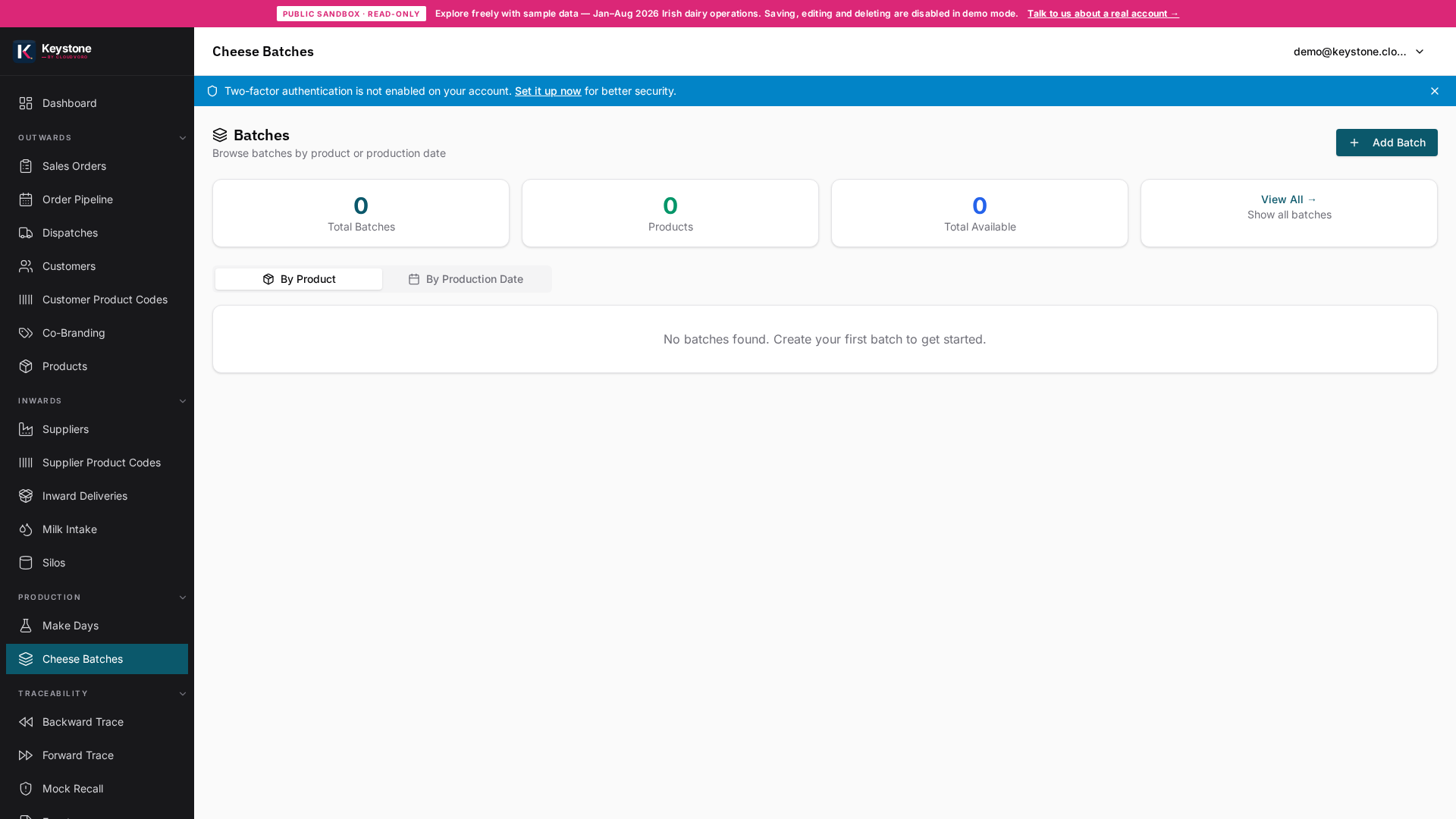
Keystone Batches (Public Sandbox demo data), production runs by product with per-batch counts.
Every make-day, every lot, every input weight. One place.
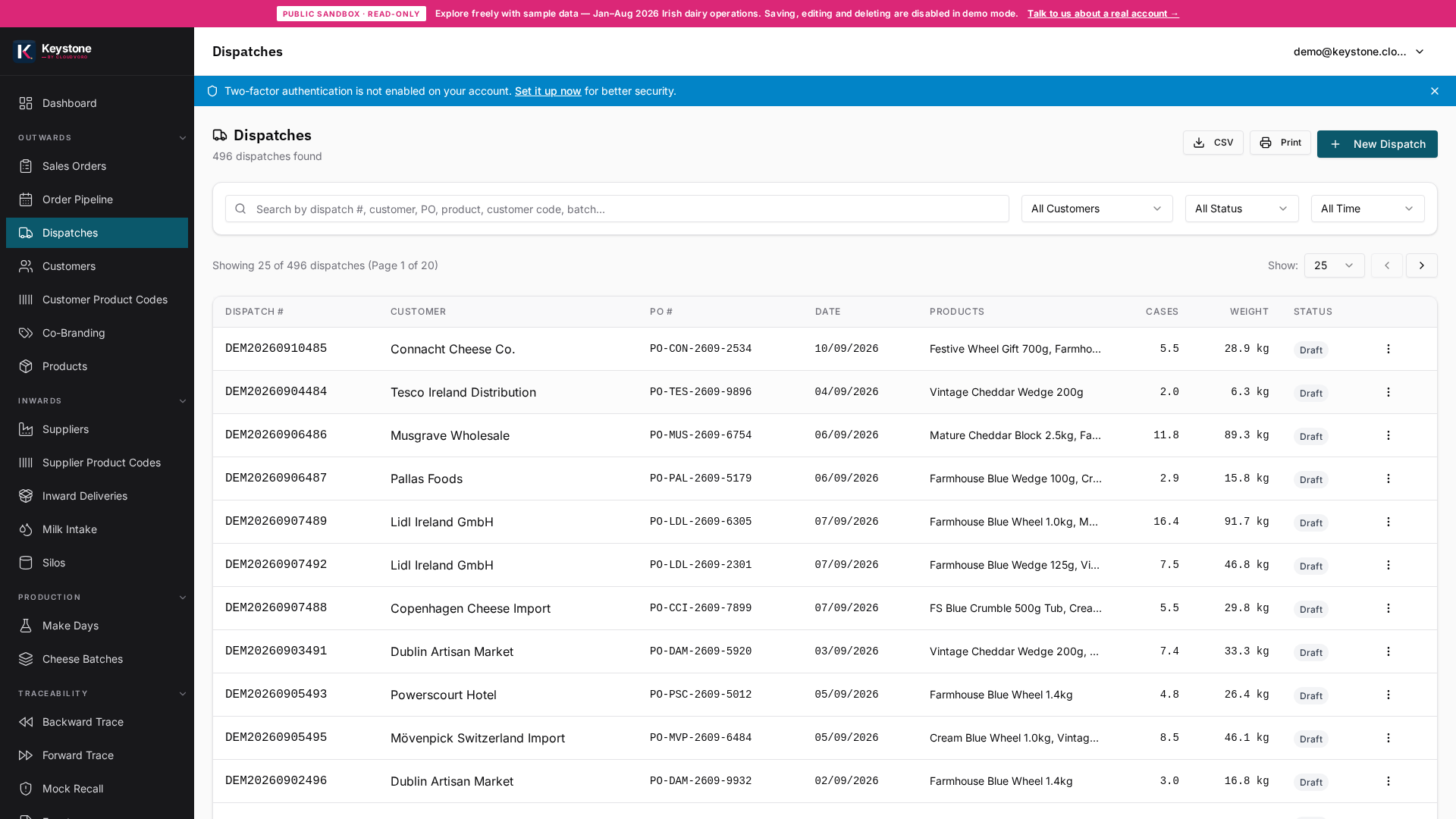
Keystone Dispatches (Public Sandbox demo data), filterable by customer / PO / status with per-line batch codes and dispatch weights.
Dispatches with batch codes and pallet weights on the line, not stapled to the back.
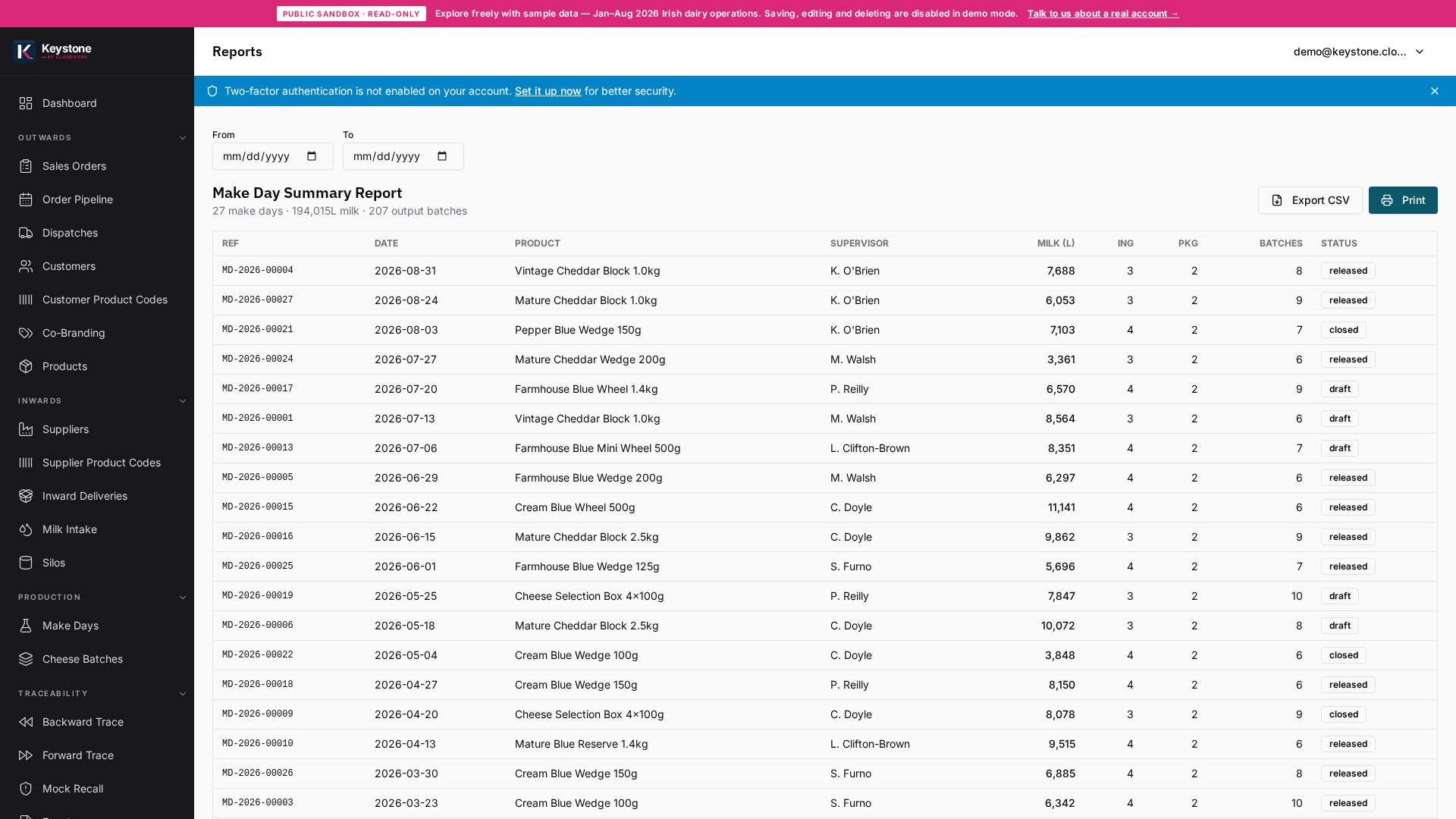
Keystone Reports (Public Sandbox demo data), make-day summary with milk usage, ingredient / packaging usage and batch counts by supervisor.
Reports built for QA managers and auditors, not for looking pretty in board meetings.
The hard problem

Transformation is where meat traceability breaks.

A spreadsheet can track a cheese batch that stays one thing. A side of beef does not stay one thing, it becomes striploins, mince, trim for burgers, bones for stock, each processed on different days and dispatched to different customers. Keystone's transformation model records each cutting or processing step as a link: input lots with weights in, output lots with weights out. The yield is visible per transformation, the mass balance closes at every step, and both trace directions survive the whole tree, from a single intake lot to every retail pack it became, or backwards from a customer complaint to the intake it started as.

Sector obligations

Built around what meat businesses must evidence.

Regulatory identity
Beef traceability rules (EU Reg. 1760/2000) demand identity through the chain; approved establishments carry DAFM (IE) or FSA (UK) obligations. Keystone holds the lot references your paperwork must produce on demand.
Kill date / use-by discipline
Date attributes travel with lots through transformations, so short-life outputs inherit correct dating and FEFO dispatch is enforceable.
Weight-variable everything
Catch weights at intake, at each transformation, and at dispatch, reconciled, not rounded away into a shrinkage account.
Retailer audits
BRCGS vertical audits pick a pack and walk backwards. With the transformation tree in one record, that walk is a screen-share, not an archaeology dig.
Honest scope

Processors and cutting plants, not full abattoir compliance suites.

Keystone is the batch traceability, QC and dispatch layer for meat processors, cutting plants and butchery producers supplying retail and foodservice. It is not an abattoir kill-line system or a movement-permit platform, it sits after intake, holding the lot chain your audits and your customers query. Founding partner is an Irish farmhouse dairy; the transformation model was built general because every batch producer eventually splits, blends or reworks lots.

Keep reading

Related pages on this stack.

FAQ

Questions buyers actually ask.

Can one intake lot become many products?
Yes, transformations are first-class: input lots and weights in, output lots and weights out, chained to any depth. Forward and backward trace survive the whole tree, and yield per step is visible.
Does it handle catch weights?
Natively. Units, cases and pallets carry actual weights, reconciled at intake, transformation and dispatch. Variance is visible instead of vanishing.
Can we trace to kill date or herd reference?
Intake lots carry the supplier references you record, kill date, slaughter batch, supplier lot. Those references travel with the chain and appear in trace reports on demand.
Is this an abattoir system?
No. Keystone is the post-intake production layer: lots, transformations, QC, dispatch, labels and traceability for processors and cutting plants. Kill-line and animal-movement systems remain separate.
What do audits get?
A signed PDF chain for any lot, intake references, every transformation with weights, every dispatch with customers and quantities, plus an tamper-evident audit log of who recorded what, when.

Ready to see if Keystone fits your floor?

20-minute discovery call. No sales pitch. Written scope within 48 hours if we fit, referral to someone better if we don't.

Talk to us
Compliance & trust

How we keep your
data and your audits safe.

Enterprise-grade controls as standard, encryption, MFA for every user, tenant isolation and tamper-evident audit trails, on EU cloud or your own servers. Privacy queries go to privacy@cloudvoro.com. Sub-processor list at /legal/sub-processors. Full security posture at /site/security.

Live
Hosted in EU / Ireland, or on-premise
Customer data resides on AWS Ireland (eu-west-1) and never leaves the EU. Local on-premise deployment available where policy requires it.
Live
GDPR · Privacy Contact named
Internal Data Protection Lead handles subject access requests. Owner is ADPO Ireland member.
Live
MFA for every user
TOTP multi-factor authentication across all roles, with rate limiting, brute-force lockout and reCAPTCHA bot protection on public forms.
Live
ISO 27001 · aligned controls
Security controls mapped to the ISO/IEC 27001:2022 Annex A framework, access management, encryption, logging, incident response.
Live
NIS2 · supporting evidence
Tenant isolation, MFA and tamper-evident audit trails give customers in NIS2 scope direct supporting evidence for their obligations.
Live
Encryption · at rest & in transit
TLS 1.3 in transit, industry-standard symmetric ciphers at rest, KMS-managed keys.