Keystone
by CloudVoro
Goods-in · Intake records

Goods-in software: where traceability actually starts.
Every trace you'll ever run ends at an intake record.

Every backward trace, every mass balance and every supplier-recall response terminates at the same place: the goods-in record. If intake is a carbon-copy book with 'flour x 20' scrawled at 7am, everything downstream inherits the gap. Keystone makes lot-level intake take under a minute per delivery, supplier, lot code, quantity, dates, COA, checks, and everything downstream inherits the precision instead.

  • Receive by supplier lot: code, quantity, dates, templated per supplier
  • COAs and conformance docs attached to the delivery they belong to
  • Intake checks (temperature, condition, residue status) recorded at the door
  • Every batch links to the deliveries that fed it, automatically
See it in action

Real screens, from our Public Sandbox.

Every screenshot below is captured from the Public Sandbox demo tenant with sample Irish dairy data. No mockups, no client data, no NDAs.
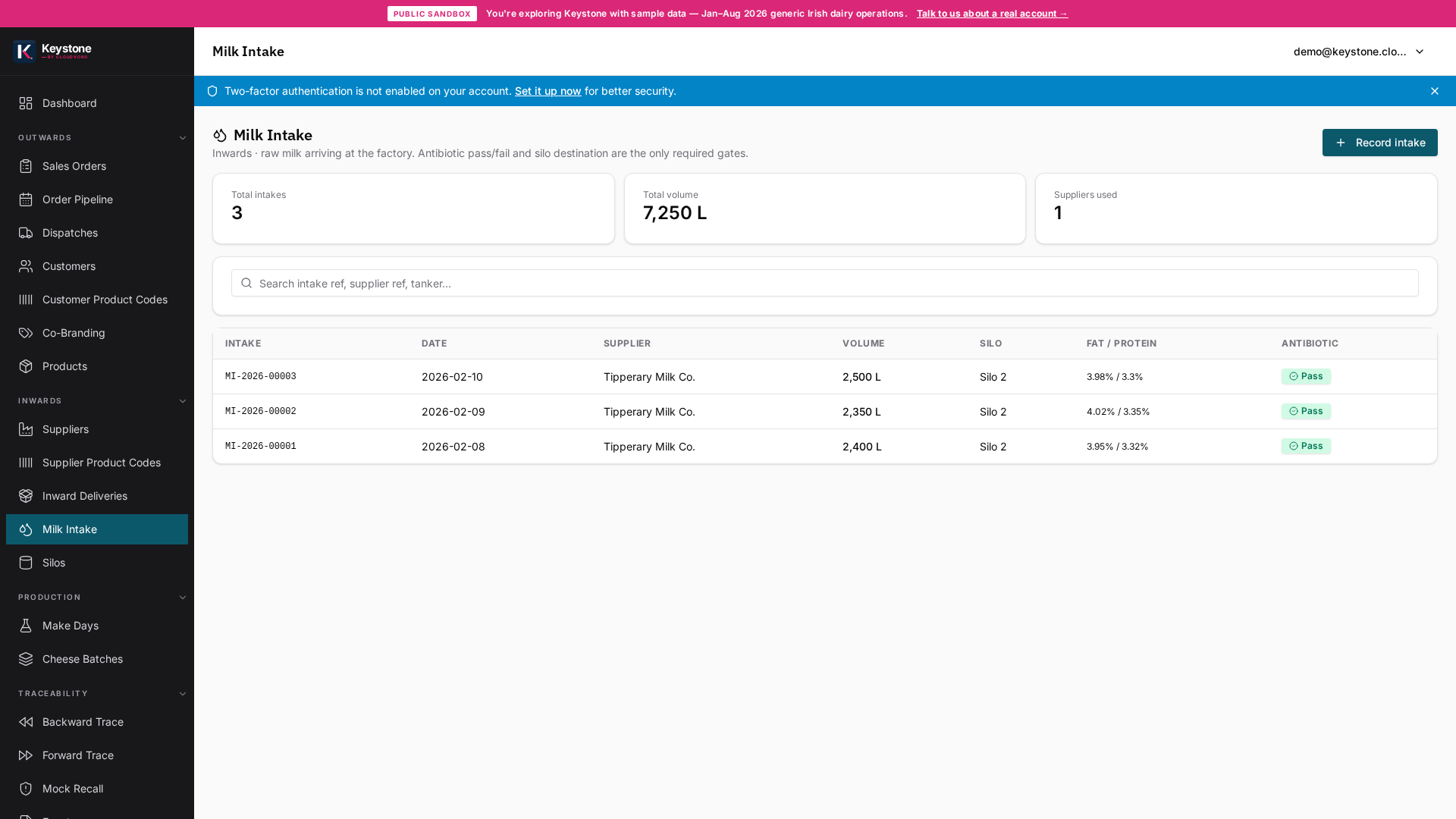
Keystone Milk Intake (Public Sandbox demo data), raw milk intakes with volume, supplier, silo destination and antibiotic pass/fail.
Goods-in becomes the first link in the traceability chain, not a paper docket in a folder.
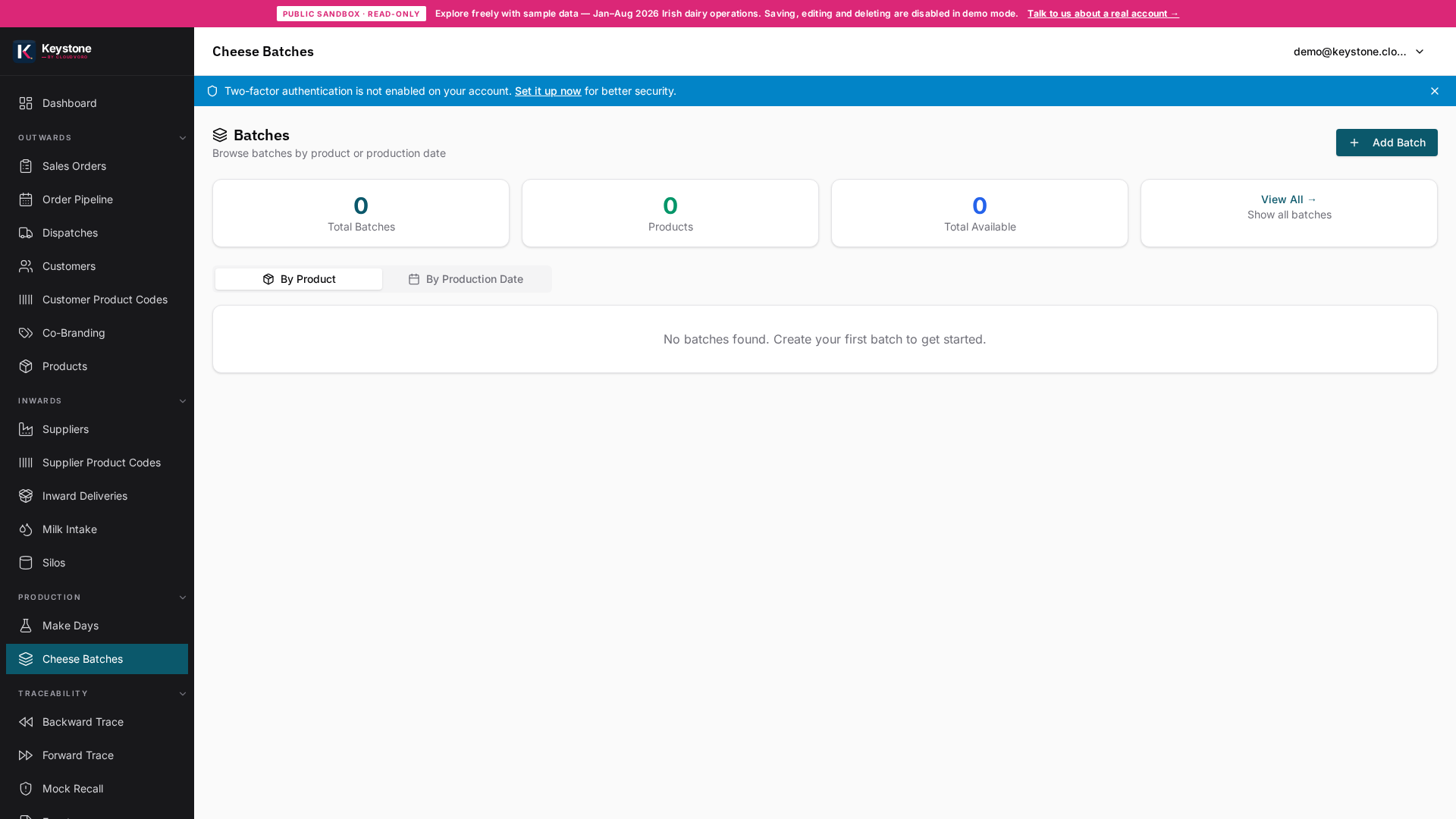
Keystone Batches (Public Sandbox demo data), production runs by product with per-batch counts.
Every make-day, every lot, every input weight. One place.
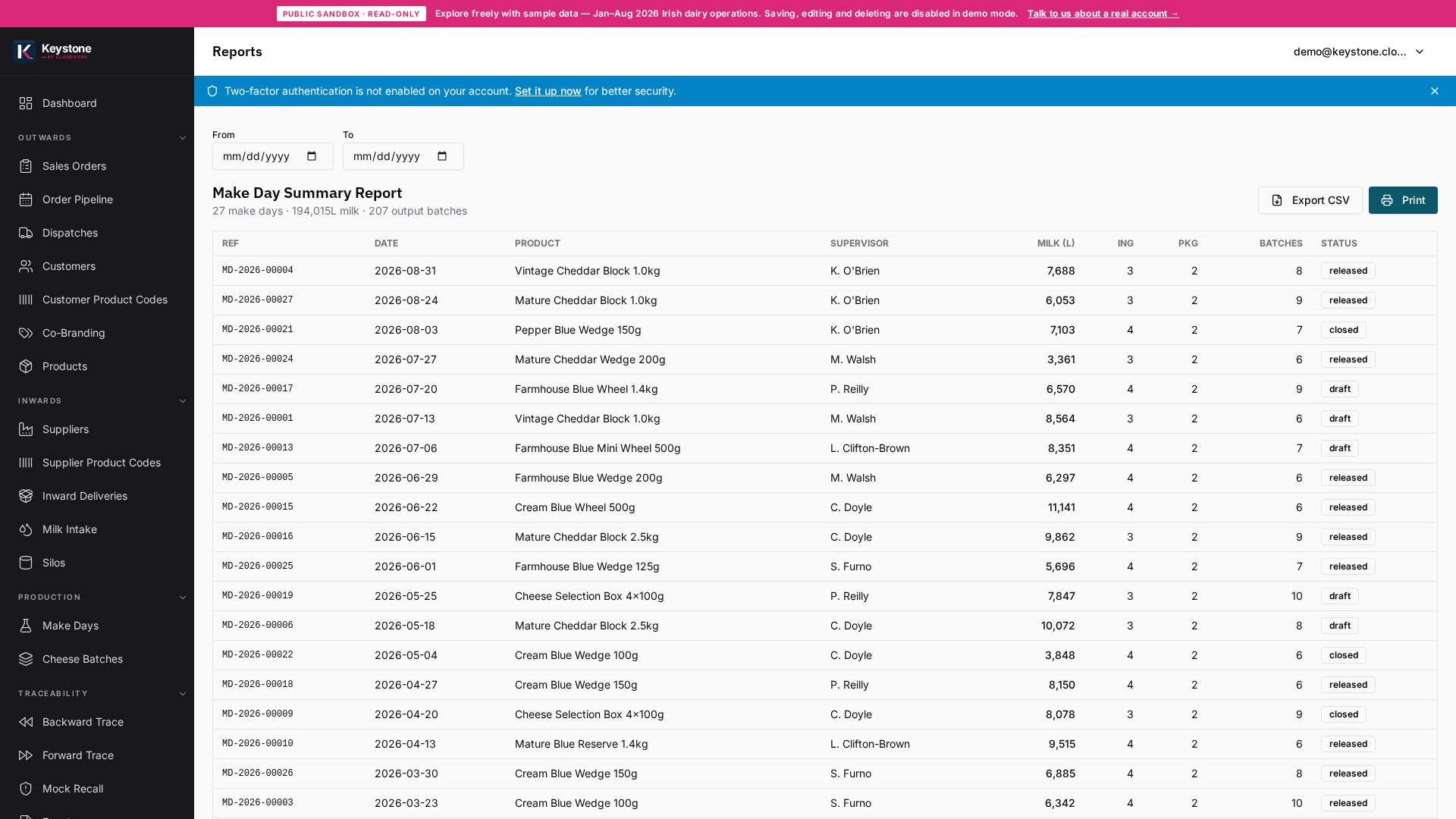
Keystone Reports (Public Sandbox demo data), make-day summary with milk usage, ingredient / packaging usage and batch counts by supervisor.
Reports built for QA managers and auditors, not for looking pretty in board meetings.
The weakest link

Audits walk upstream. Intake is where they arrive.

The vertical audit always ends the same way: the auditor follows your batch back to its raw materials and asks for the intake evidence, which supplier lot, received when, checked how, COA where? Sites with strong production records and weak intake records fail here, because clause-level requirements (BRCGS §3.5, supplier approval and raw material acceptance) assume the goods-in register is real. The fix isn't heroic discipline; it's making the record cheaper than the shortcut: supplier-templated intake screens where a regular delivery is three taps and a lot code.

What good intake looks like

A minute at the door buys hours everywhere else.

Supplier templates
Regular deliveries pre-fill product, pack sizes and expected checks, the operator adds the lot code and quantity.
Documents attached at source
COA, delivery docket, conformance cert, photographed or uploaded against the delivery, findable forever.
Checks at the door
Temperature, packaging condition, residue-clearance status, recorded on intake; failures can hold the lot from use.
Instant upstream answers
"Which deliveries fed this batch?" and "which batches used this delivery?" become one-click questions, the supplier-recall response in particular.
Downstream payoff

Intake rigour is what makes the 30-second trace possible.

Keystone's headline, full chain in under 30 seconds, is really an intake story: because deliveries are lot-level records, batches link to them automatically, and the backward trace has somewhere real to land. The same records anchor your mass balance (received vs used vs stock) and your supplier scorecards (rejections, temperature failures, doc gaps per supplier, free management data). Goods-in is included in the standard licence; it's the front door of the whole system.

Keep reading

Related pages on this stack.

FAQ

Questions buyers actually ask.

How long does booking in a delivery take?
Under a minute for a templated regular supplier: confirm the products, enter lot codes and quantities, tick the checks. Documents can be photographed at the door.
Can a failed intake check block a lot from production?
Yes, holds are enforceable. A lot awaiting residue clearance or failing temperature can be blocked from batch consumption until released.
Do you handle multi-product, multi-lot deliveries?
Yes, one delivery can carry any number of lines, each with its own lot code and checks. Packaging deliveries record the same way (BRCGS includes packaging in traceability).
What about milk or bulk liquid intake?
Keystone has dedicated milk intake and silo modules, tanker deliveries with per-farm volumes, silo runs that preserve lineage into batches. Other bulk intakes model the same way.
Can we import our supplier list and specs?
Yes, suppliers, products and supplier product codes import during implementation, so templates work from day one.

Ready to see if Keystone fits your floor?

20-minute discovery call. No sales pitch. Written scope within 48 hours if we fit, referral to someone better if we don't.

Talk to us
Compliance & trust

How we keep your
data and your audits safe.

Enterprise-grade controls as standard, encryption, MFA for every user, tenant isolation and tamper-evident audit trails, on EU cloud or your own servers. Privacy queries go to privacy@cloudvoro.com. Sub-processor list at /legal/sub-processors. Full security posture at /site/security.

Live
Hosted in EU / Ireland, or on-premise
Customer data resides on AWS Ireland (eu-west-1) and never leaves the EU. Local on-premise deployment available where policy requires it.
Live
GDPR · Privacy Contact named
Internal Data Protection Lead handles subject access requests. Owner is ADPO Ireland member.
Live
MFA for every user
TOTP multi-factor authentication across all roles, with rate limiting, brute-force lockout and reCAPTCHA bot protection on public forms.
Live
ISO 27001 · aligned controls
Security controls mapped to the ISO/IEC 27001:2022 Annex A framework, access management, encryption, logging, incident response.
Live
NIS2 · supporting evidence
Tenant isolation, MFA and tamper-evident audit trails give customers in NIS2 scope direct supporting evidence for their obligations.
Live
Encryption · at rest & in transit
TLS 1.3 in transit, industry-standard symmetric ciphers at rest, KMS-managed keys.