MRPeasy ist günstiger.
Bis Sie die Funktionen hinzufügen, die eine Lebensmittelfabrik wirklich braucht.
MRPeasy ist ein hervorragendes generisches MRP-Tool zu einem guten Preis. Es richtet sich an jeden, der Stücklisten zusammenstellt — Fahrräder, Möbel, Elektronik, Kosmetik. Lebensmittel sind anders: chargen mit variablem Gewicht, Händler‑Chargebacks, Catch‑Weight‑Abrechnung, Allergen‑Leitern, Kill‑Sheet‑Abgleiche, Proberückrufe. Hier sehen Sie, was der Listenpreis verschweigt — basierend auf den von MRPeasy veröffentlichten Preisen (Stand 2026).
- MRPeasy mit 20 Benutzern auf dem für Lebensmittel tauglichen Enterprise‑Tarif: ~€980/Monat
- + externes Retailer‑EDI‑Middleware: ~€300/Monat
- + externes COA/Traceability‑Add‑on: ~€200/Monat
- Wahrer Aufwand bei 20 Benutzern: €1.480+/Monat, und es fehlen immer noch native Food‑Workflows
- Keystone: one flat per-site licence, unlimited users, food-native from day 1
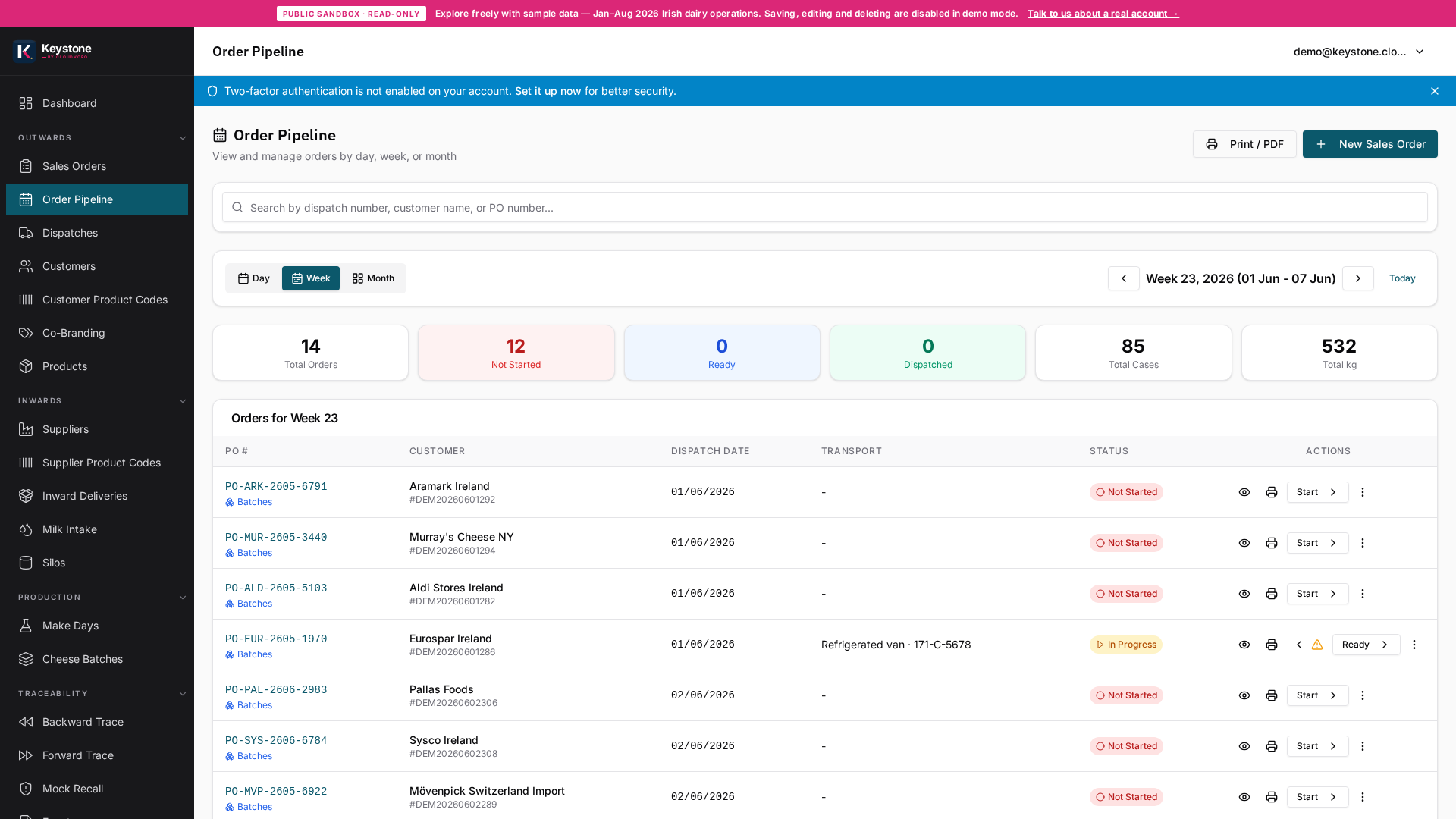
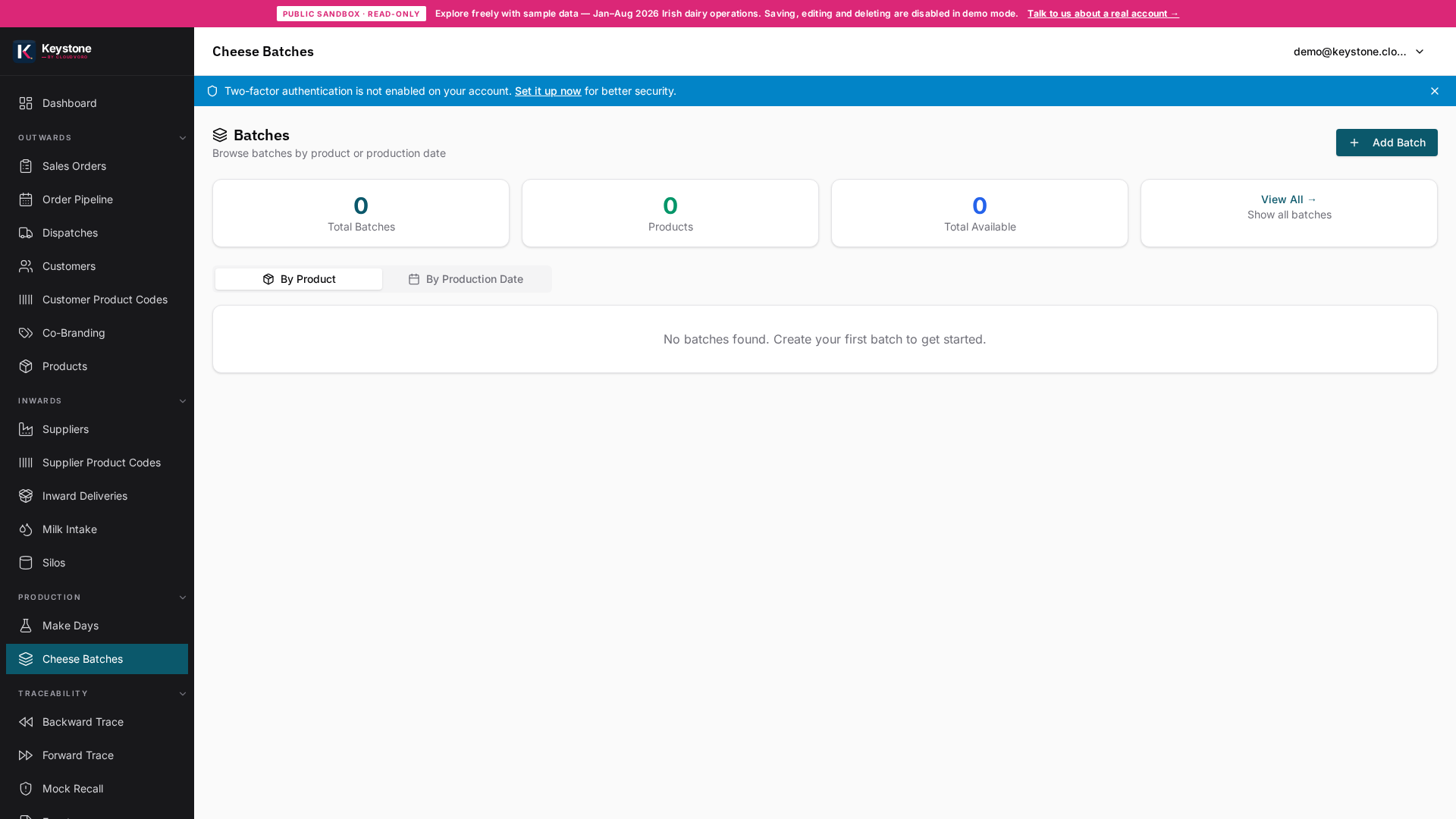
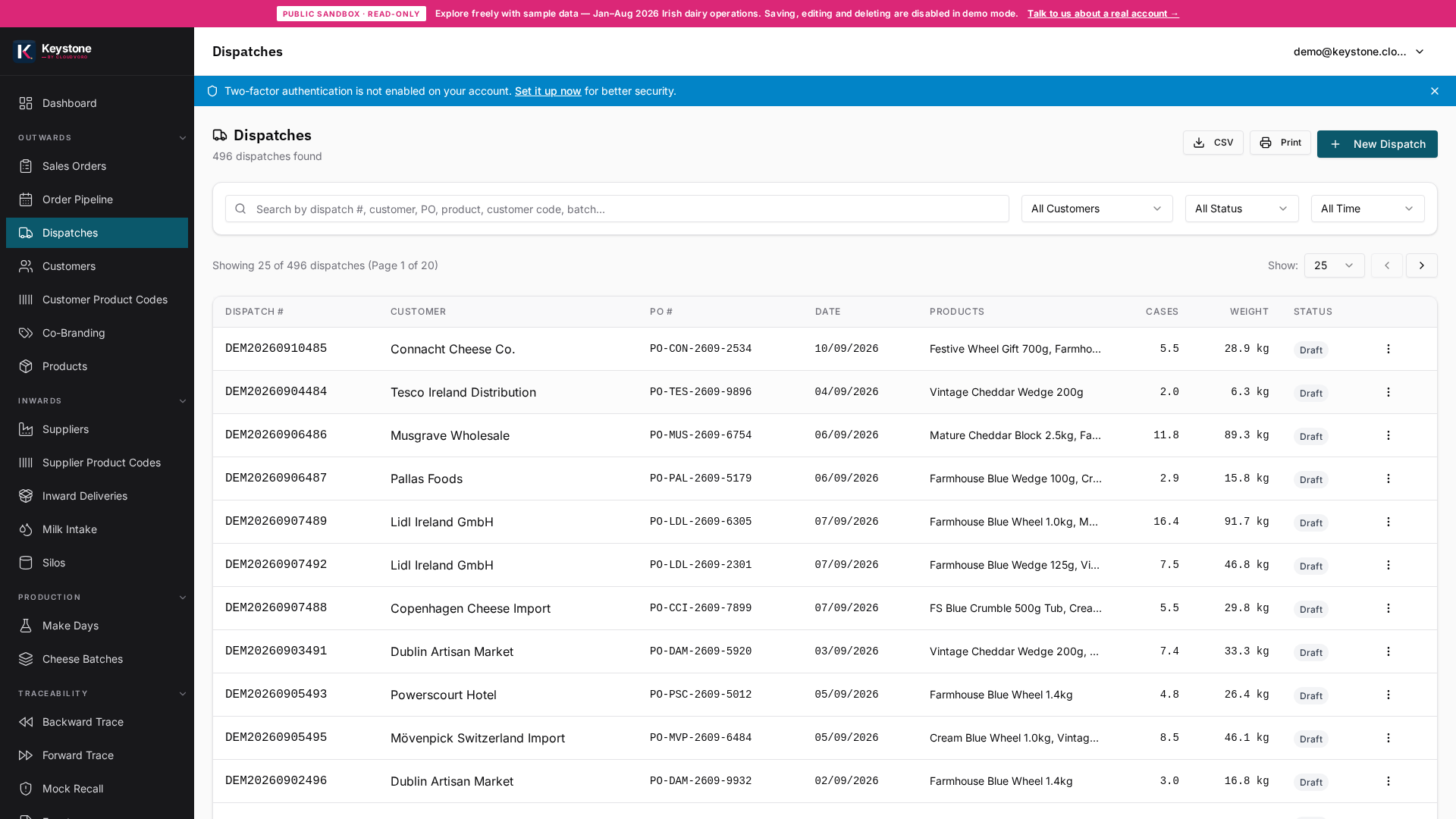
Real screens, from our Public Sandbox.
Every screenshot below is captured from the Public Sandbox demo tenant with sample Irish dairy data. No mockups, no client data, no NDAs.
MRPeasy ist großartig — für den richtigen Käufer.
If you make bikes, furniture, cosmetics or electronics, MRPeasy is one of the best-value MRP tools on the market. Cloud-native, decent UX, no implementation fee, monthly billing. For a small workshop shipping stock to a distributor, it works. The mismatch shows up when a food manufacturer tries to bend it into shape, because MRPeasy has no concept of catch-weight, no retailer EDI, no HACCP records, no allergen ladders, no kill-sheet reconciliation, and no mock-recall workflow. Those aren't nice-to-haves for a food factory. They're the difference between shipping and being audited.
Die Zahl auf den ersten Blick vs. die tatsächlichen Kosten.
| Leistungsmerkmal | Excel | Keystone |
|---|---|---|
| Entry price | ✗ MRPeasy Starter: $49/user/mo | ✓ Keystone: flat per-site licence, unlimited users |
| Food-viable tier | ✗ MRPeasy Enterprise: $99/user/mo (needs Serial Numbers, Barcoding, MPS) | ✓ Keystone: all modules included in one licence |
| 20-user monthly cost | ✗ ~$1,069/mo (Enterprise) ≈ €980/mo | ✓ Flat per-site · same 20 users · no per-user growth |
| Retailer EDI (ASN, Tesco/Lidl/M&S) | ✗ Not included, bolt-on middleware ~€300/mo | ✓ Native, retailer-formatted from day 1 |
| Catch-weight invoicing | ✗ Not supported | ✓ Native, variable weight per line, PO tolerance modes |
| HACCP + COA records | ✗ Excel bolt-on | ✓ Native, per batch, auto-attached to dispatch |
| Kill-sheet reconciliation (meat) | ✗ Not supported | ✓ Native, supplier locking, first-pass yield |
| Allergen ladder per recipe | ✗ Manuell | ✓ Native, mass-balance audit on every batch |
| Mock-recall workflow | ✗ Not included, Excel handoff | ✓ Under 90 seconds, signed PDF |
| Implementation approach | ✗ Self-serve import from CSV | ✓ Fixed-fee, two-day on-site, 30-day hand-holding |
| Support model | ✗ Ticket system, add-on training $150/hr | ✓ Direct line to the founding build team |
| True cost @ 20 users, food-native | ✗ ~€1,480/mo (Enterprise + EDI + COA) | ✓ Flat per-site · all-in · food-native |
Wir behaupten nicht, dass jeder Keystone braucht.
If (a) you don't supply retailers who demand EDI or formatted ASNs, (b) you don't work with variable-weight or catch-weight products, (c) allergen and HACCP records live in a physical folder that works for you, and (d) your traceability requirement is a single-lot lookup rather than a full mock-recall drill, then MRPeasy at $49–99/user/month is a very reasonable choice, and you should try it. Come back to us when a retailer sends you a chargeback dispute, an auditor asks for 12 months of batch genealogy in 60 minutes, or you add your first catch-weight SKU. That's the day the maths flips.
Related pages on this stack.
Fragen, die Einkäufer tatsächlich stellen.
Ist MRPeasy tatsächlich günstiger als Keystone?
Was deckt MRPeasy nicht für die Lebensmittelherstellung ab?
Kann ich von MRPeasy zu Keystone migrieren?
Was, wenn ich bereits MRPeasy nutze und es gut funktioniert?
Bereit herauszufinden, ob Keystone zu Ihrer Produktion passt?
20‑minütiges Kennenlerngespräch. Kein Verkaufsgespräch. Schriftlicher Leistungsumfang innerhalb von 48 Stunden, falls wir zueinander passen; andernfalls Empfehlung an einen geeigneteren Anbieter.
Kontaktieren Sie uns