Keystone
by CloudVoro
GS1-128 · SSCC pallet labels

GS1-128 and SSCC labels from real batch data.
The barcode is easy. The data behind it is the product.

Any label tool can draw a GS1-128 barcode. The hard part is what the barcode claims: the GTIN, the batch in AI(10), the dates, the SSCC serial, all matching the physical pallet and your dispatch paperwork, every time. Keystone generates case and pallet labels from the same records that drive your dispatch notes, so the label, the pallet and the paperwork can't disagree.

  • SSCC serials generated and tracked per pallet, no reuse, full history
  • GS1-128 with the AIs retailers expect: GTIN, batch/lot (10), dates (15/17), weight
  • Label data comes from the dispatch record, no re-typing, no mismatch
  • Designed in-app, tested against real scanners before first live dispatch
See it in action

Real screens, from our Public Sandbox.

Every screenshot below is captured from the Public Sandbox demo tenant with sample Irish dairy data. No mockups, no client data, no NDAs.
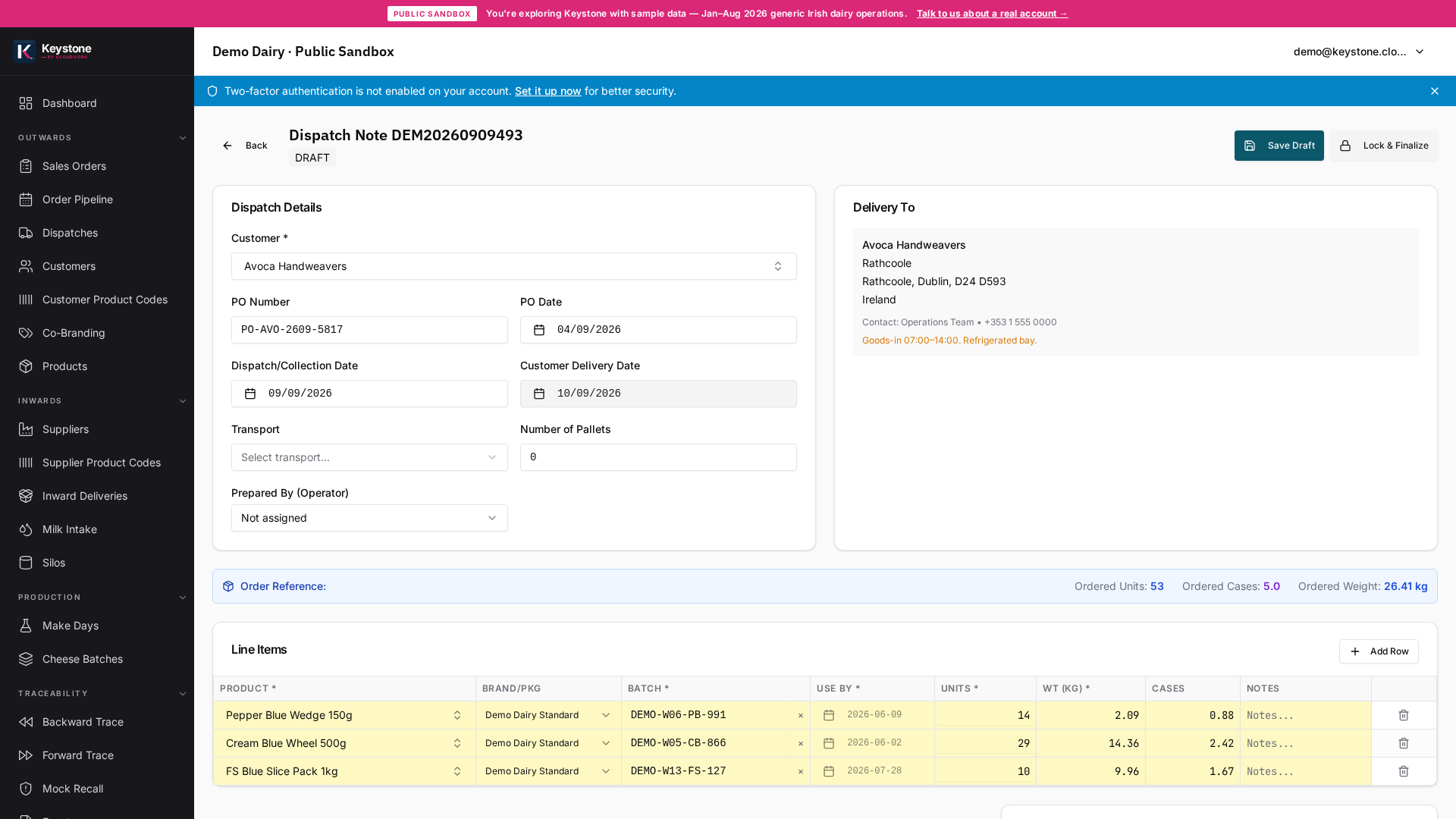
Keystone dispatch note editor (Public Sandbox demo data), customer header, PO number, delivery address, line items with batch codes and use-by dates.
What the driver hands over. What the retailer’s goods-in team scans. What the auditor sees.
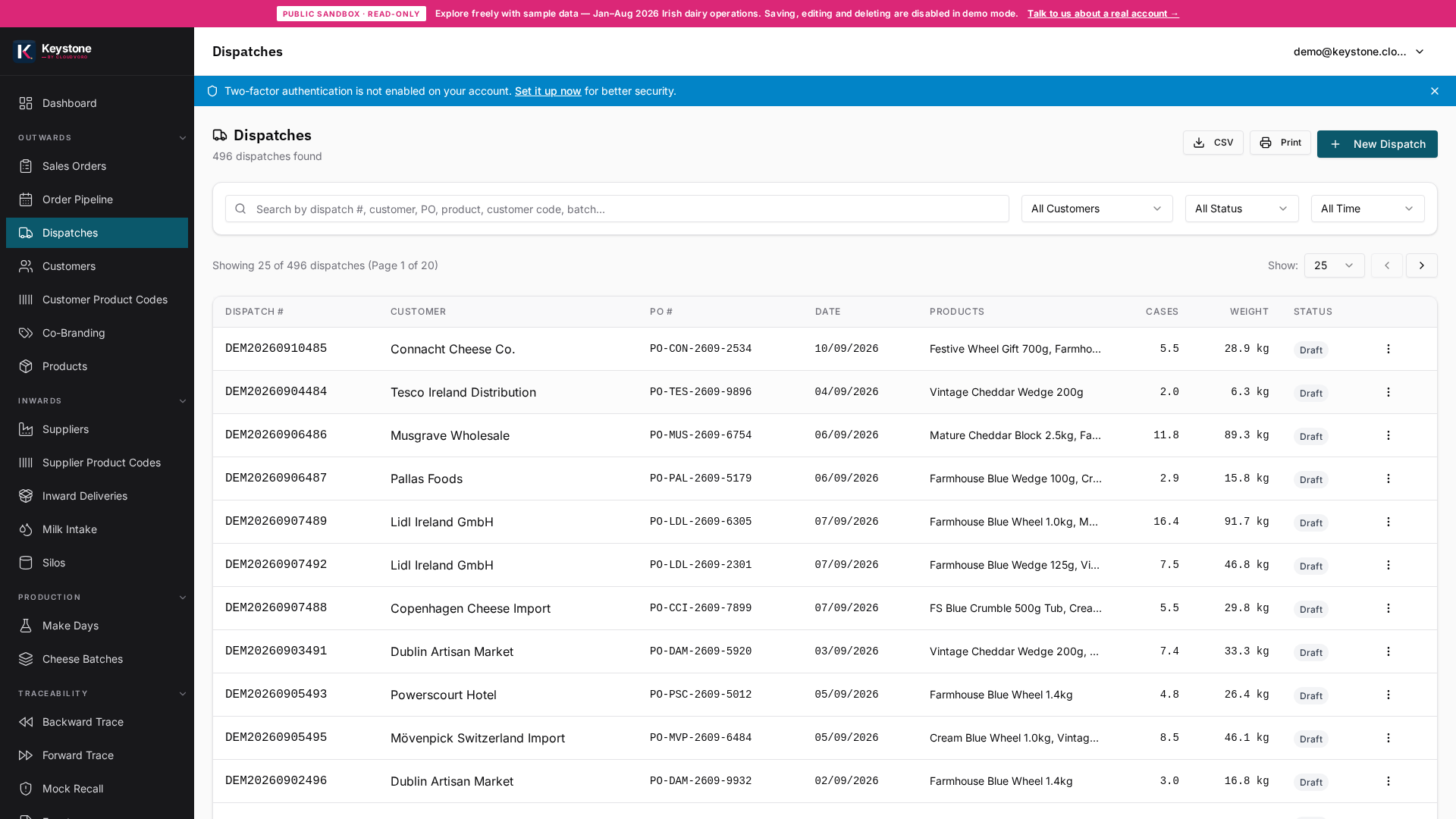
Keystone Dispatches (Public Sandbox demo data), filterable by customer / PO / status with per-line batch codes and dispatch weights.
Dispatches with batch codes and pallet weights on the line, not stapled to the back.
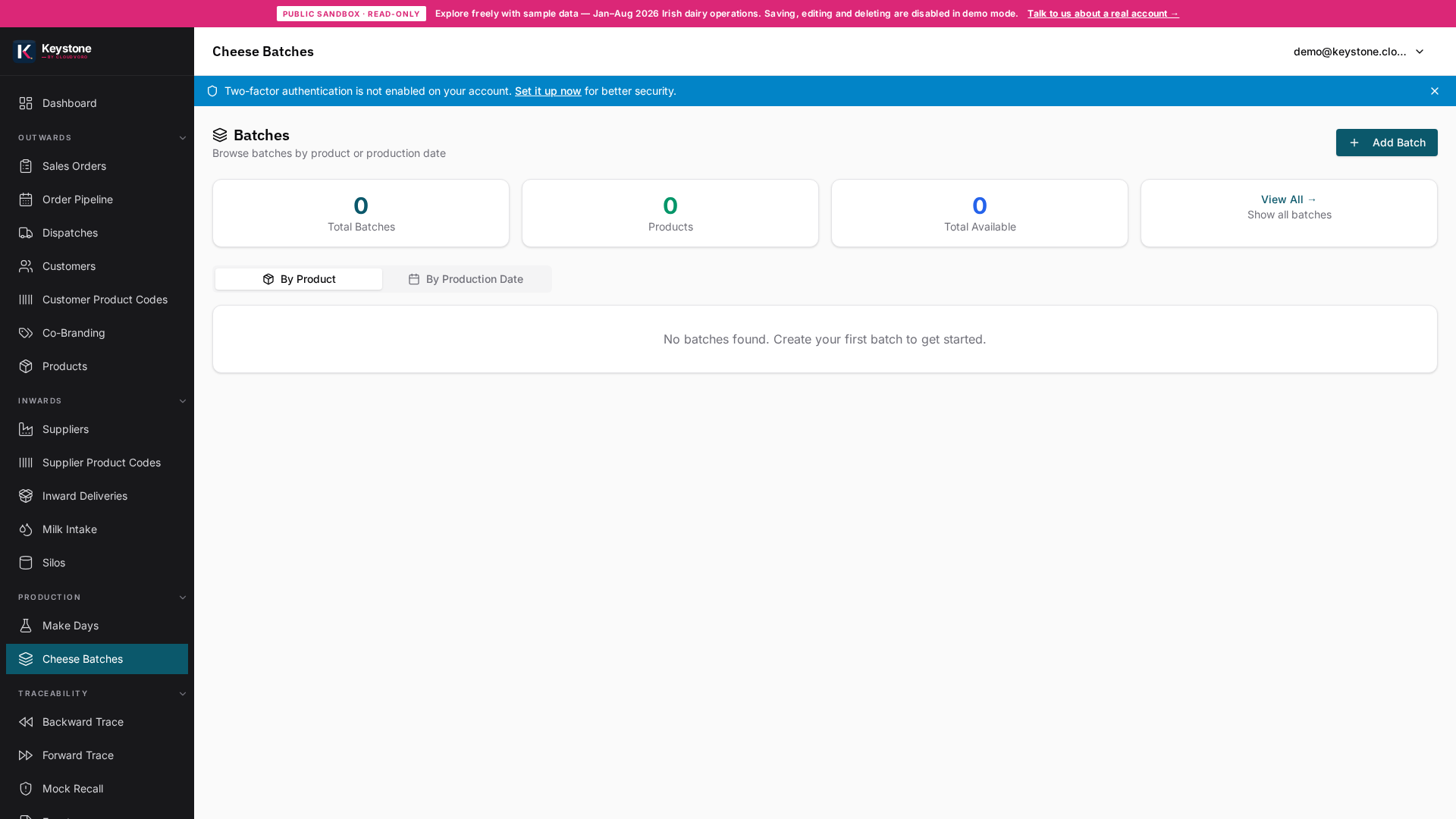
Keystone Batches (Public Sandbox demo data), production runs by product with per-batch counts.
Every make-day, every lot, every input weight. One place.
Why labels fail at the depot

Rejections are data mismatches, not print quality.

When a retailer depot rejects a pallet, it's rarely the barcode's print density, it's the data: an SSCC that duplicates a previous delivery, a batch number on the label that differs from the dispatch note, a date format the depot's system won't parse. These are symptoms of labels generated in a separate tool from separate keystrokes. Keystone's labels render from the dispatch record itself: the batch is the batch that's actually on the pallet, the SSCC is issued once from a tracked sequence, and the dispatch note quotes the same identifiers, because they're the same data.

What you get

The full case-and-pallet labelling layer.

SSCC management
Serial references generated per pallet from your GS1 company prefix, never reused, with a full history of what shipped under each.
Retailer-specific layouts
Label formats configured per customer against their supplier manual, logotypes, field order, human-readable sections.
Catch-weight support
Variable-weight AIs carry the actual weights from the dispatch record, matching your COA and invoice.
Traceability built in
Every SSCC links to its batches, so a depot query quoting only a pallet number resolves to the full chain in seconds.
Practical honesty

You bring the GS1 prefix; we make it work.

You need your own GS1 company prefix (from GS1 Ireland or GS1 UK), that's a membership, not software. Keystone consumes it: GTIN allocation records, SSCC sequences, and label rendering are then handled in-app, and we test against real scanners during implementation before anything ships. Labelling is part of the standard licence, not a paid module.

Keep reading

Related pages on this stack.

FAQ

Questions buyers actually ask.

Do I need a GS1 membership?
Yes, SSCC and GTIN identifiers derive from your own GS1 company prefix (GS1 Ireland or GS1 UK membership). Keystone manages the sequences and rendering once you have it.
Which application identifiers are supported?
The set retail supply chains use: SSCC (00), GTIN (01/02), batch/lot (10), dates (11/15/17), quantity (37) and variable-weight AIs. Layouts are configured per customer requirement.
Can labels handle mixed pallets?
Yes, a pallet can carry multiple batches and products; the SSCC record knows its full contents, and depot-level queries resolve to everything on it.
What printers work?
Any printer that accepts standard label PDFs; direct thermal workflows (Zebra et al.) are configured during implementation and tested with your scanners.
Is this a separate module or extra cost?
Included in the standard €790/month licence, like every module. Retailer-specific layout configuration happens during implementation.

Ready to see if Keystone fits your floor?

20-minute discovery call. No sales pitch. Written scope within 48 hours if we fit, referral to someone better if we don't.

Talk to us
Compliance & trust

How we keep your
data and your audits safe.

Enterprise-grade controls as standard, encryption, MFA for every user, tenant isolation and tamper-evident audit trails, on EU cloud or your own servers. Privacy queries go to privacy@cloudvoro.com. Sub-processor list at /legal/sub-processors. Full security posture at /site/security.

Live
Hosted in EU / Ireland, or on-premise
Customer data resides on AWS Ireland (eu-west-1) and never leaves the EU. Local on-premise deployment available where policy requires it.
Live
GDPR · Privacy Contact named
Internal Data Protection Lead handles subject access requests. Owner is ADPO Ireland member.
Live
MFA for every user
TOTP multi-factor authentication across all roles, with rate limiting, brute-force lockout and reCAPTCHA bot protection on public forms.
Live
ISO 27001 · aligned controls
Security controls mapped to the ISO/IEC 27001:2022 Annex A framework, access management, encryption, logging, incident response.
Live
NIS2 · supporting evidence
Tenant isolation, MFA and tamper-evident audit trails give customers in NIS2 scope direct supporting evidence for their obligations.
Live
Encryption · at rest & in transit
TLS 1.3 in transit, industry-standard symmetric ciphers at rest, KMS-managed keys.