Sie haben kein Dashboard-Problem.
Sie haben ein Tabellenkalkulationsproblem.
Excel funktioniert. Bis es nicht mehr funktioniert. Hier ein Vergleich dessen, was sich ändert, wenn Sie chargenbezogene Rückverfolgbarkeit, Versand und COAs von Tabellenkalkulationen in Keystone verlagern – mit den genauen Kennzahlen, die unser Gründungspartner vor und nach der Umstellung gemessen hat.
- Auditbereit: Rückverfolgungsabfrage unter 30 Sekunden (vorher: 2+ Stunden)
- Übergaberisiko: null. Das System hält das Wissen (vorher: eine Person)
- BRCGS-Übungsrückruf: 90 Sekunden (vorher: einen halben Tag)
- Ablehnungsrate von Lieferscheinen: null. Im Format des Einzelhändlers (vorher: ~5–8%)
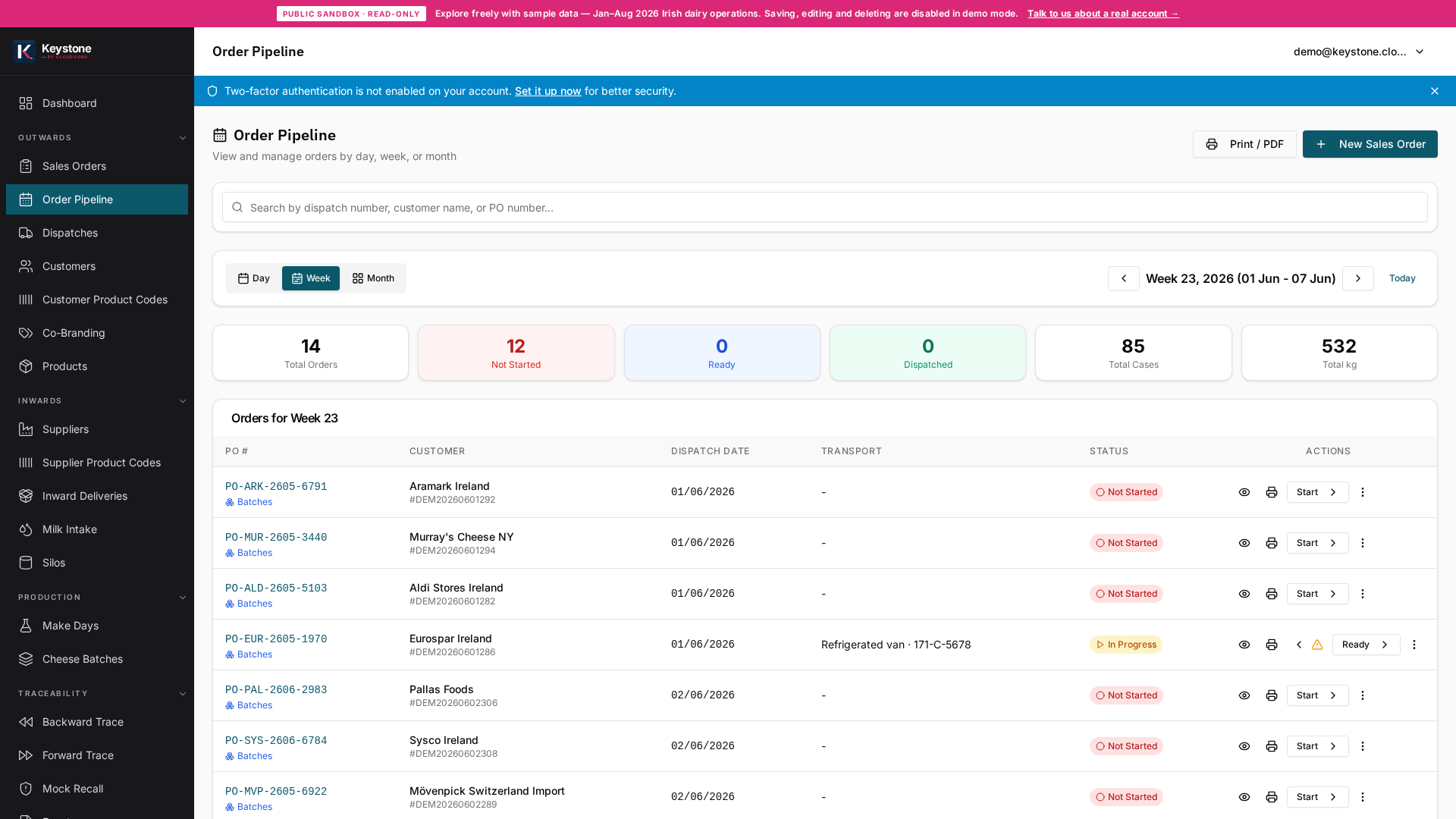
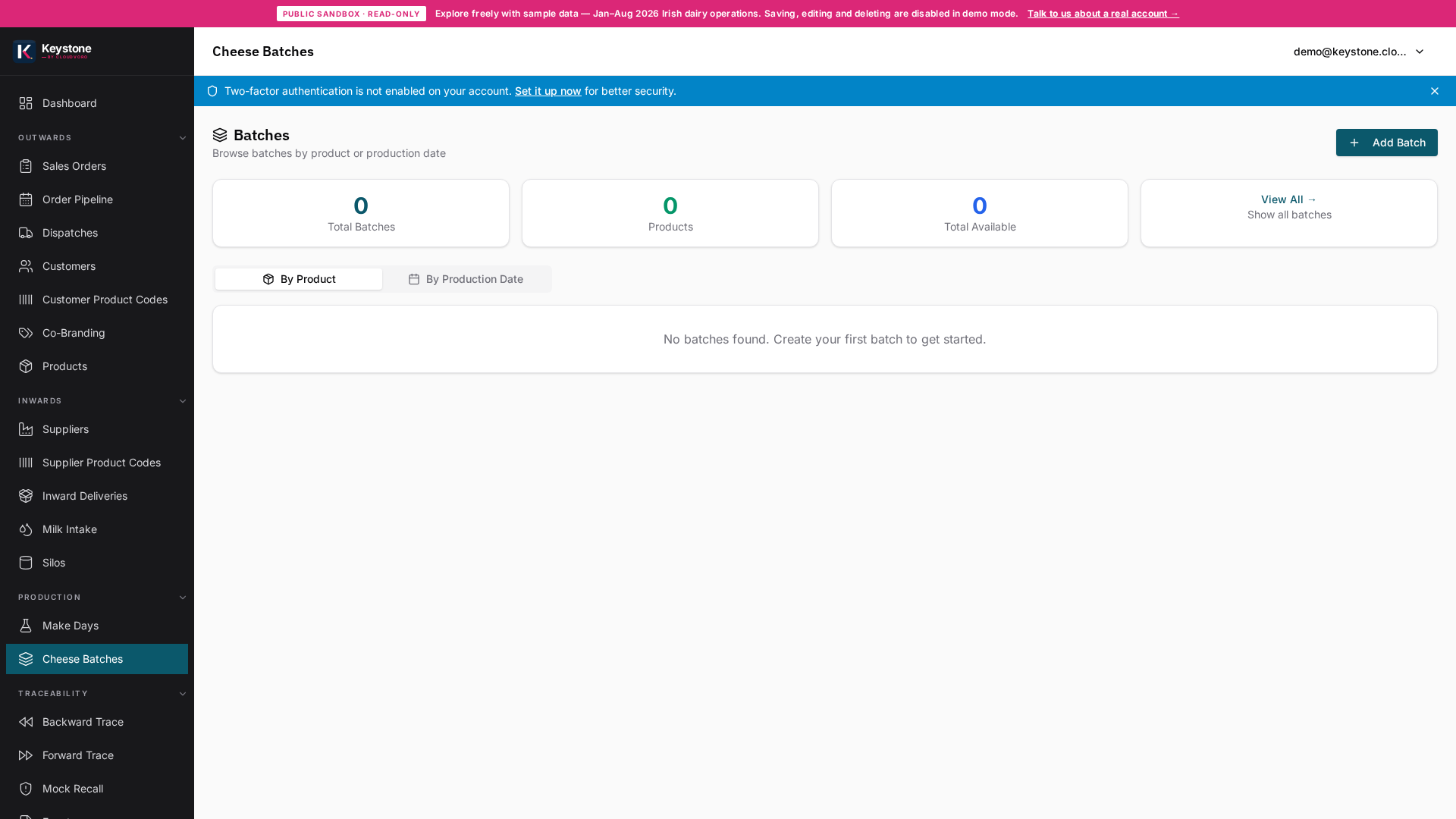
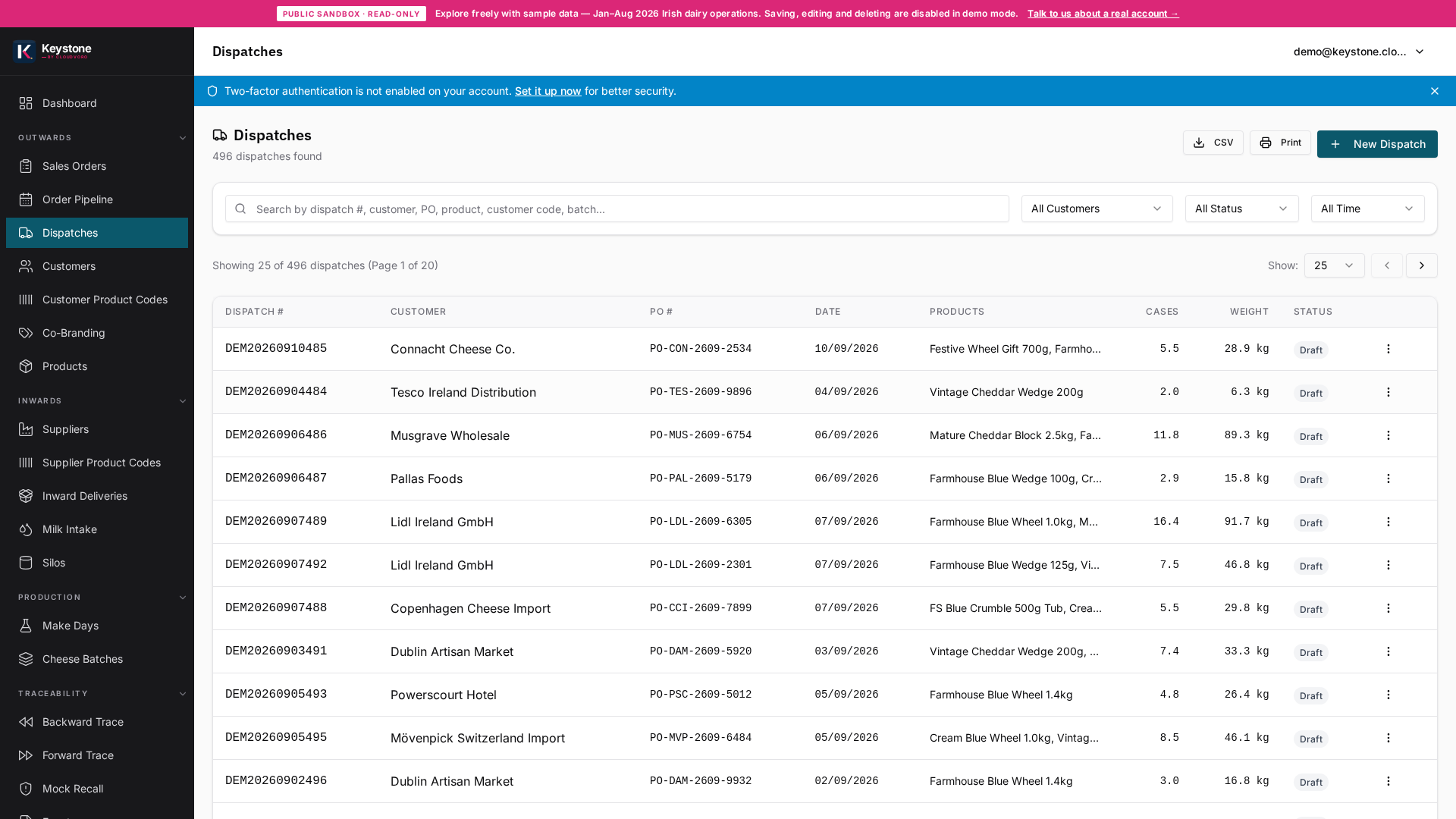
Real screens, from our Public Sandbox.
Every screenshot below is captured from the Public Sandbox demo tenant with sample Irish dairy data. No mockups, no client data, no NDAs.
Tabellenkalkulationen sind großartig. Bis die FSAI anruft.
Die meisten irischen handwerklichen Lebensmittelhersteller betreiben ihren gesamten Betrieb mit einer sorgfältig gestalteten Excel-Arbeitsmappe, meist erstellt von einer einzigen Person, die weiß, wo jede Formel liegt. Es ist clever. Es ist kostenlos. Es funktioniert. Das Problem ist nicht die Tabelle selbst, sondern alles, was von ihr abhängt: Rückverfolgbarkeit, Audit‑Bereitschaft, Händleranforderungen, Nachfolgerisiko. Sobald diese eine Person im Urlaub ist und ein SFPA‑Inspektor hereinkommt, bricht das System zusammen.
Was sich tatsächlich ändert.
| Leistungsmerkmal | Excel | Keystone |
|---|---|---|
| Traceability lookup (full chain) | ✗ 2+ hours, manual | ✓ Under 30 seconds, one query |
| Mock-recall (BRCGS) | ✗ Ein halber Tag, fehleranfällig | ✓ 90 seconds, signed PDF |
| Prüfprotokoll | ✗ None, last-saved version only | ✓ Immutable, who/when/why on every change |
| Übergaberisiko | ✗ High, one person holds the knowledge | ✓ Zero, the system holds the workflow |
| Lieferscheine | ✗ Generic Word doc, often rejected | ✓ Retailer-formatted, audit-trail per send |
| COAs pro Charge | ✗ Manual copy-paste | ✓ Auto-attached to every dispatch |
| Kunden-SKU-Zuordnung | ✗ Lookup tables | ✓ Native, bidirectional, with reverse-lookup |
| Concurrent users | ✗ One at a time, file locks | ✓ Whole team, real-time |
| Backup | ✗ Hope the laptop survives | ✓ Daily encrypted, 30-day point-in-time restore |
| Cost | ✗ Free upfront. Expensive when it fails. | ✓ One flat per-site licence, quoted to the size of your operation |
Wir tun nicht so, als bräuchte uns jeder.
Excel is still the right answer if you tick all three of these boxes: (a) your business is under roughly €1m in annual revenue, (b) you make essentially one SKU, one cheese, one bake, one cut, with maybe a couple of pack sizes, and (c) you don't supply national retailers (Tesco / SuperValu / Lidl / Aldi / Dunnes / M&S). At that scale a well-built workbook is fine. The threshold flips when any of the following are true: you're losing two hours a week chasing traceability, you're getting dispatch notes rejected by a retailer, a BRCGS audit is on the calendar in the next 12 months, or you're worried about what happens when the one person who knows the spreadsheet is on leave. At that point a right-sized licence buys back the time, the audit confidence and the handover safety.
Related pages on this stack.
Fragen, die Einkäufer tatsächlich stellen.
Können Sie unsere bestehenden Excel‑Daten importieren?
Was, wenn ich Excel für einige Dinge weiterhin nutzen möchte?
Wird mein Team es wirklich nutzen?
Was passiert, wenn Sie aus dem Geschäft gehen?
Bereit herauszufinden, ob Keystone zu Ihrer Produktion passt?
20‑minütiges Kennenlerngespräch. Kein Verkaufsgespräch. Schriftlicher Leistungsumfang innerhalb von 48 Stunden, falls wir zueinander passen; andernfalls Empfehlung an einen geeigneteren Anbieter.
Kontaktieren Sie uns