Allergenmanagement mit Nachweisen auf Chargenebene.
Denn ‚das Etikett war korrekt‘ muss pro Charge belegbar sein.
Nicht deklarierte Allergene sind die häufigste Ursache für Produktrückrufe in Irland und Großbritannien, und fast jeder Fall lässt sich auf dieselbe Lücke zurückführen: Das Etikett sagt das eine, die Charge enthält etwas anderes, und keine Aufzeichnung verbindet beides. Keystone schließt diese Lücke strukturell: Jede Charge trägt ihre Rezepturversion und die tatsächlich verbrauchten Zutatenchargen, sodass die Deklaration auf dem Etikett einen chargenspezifischen Nachweisweg hat.
- Jede Charge dokumentiert ihre Rezepturversion und die tatsächlich verbrauchten Zutatenchargen
- Lieferanten‑Allergenmeldung → betroffene Chargen und Kundenliste in Minuten
- Versionierte Spezifikationen: historische Chargen werden mit der zum Herstellungszeitpunkt gültigen Rezeptur abgeglichen
- Unterstützt die Deklarationssorgfalt gemäß FIC (Reg. 1169/2011) durch belastbare Aufzeichnungen
Real screens, from our Public Sandbox.
Every screenshot below is captured from the Public Sandbox demo tenant with sample Irish dairy data. No mockups, no client data, no NDAs.
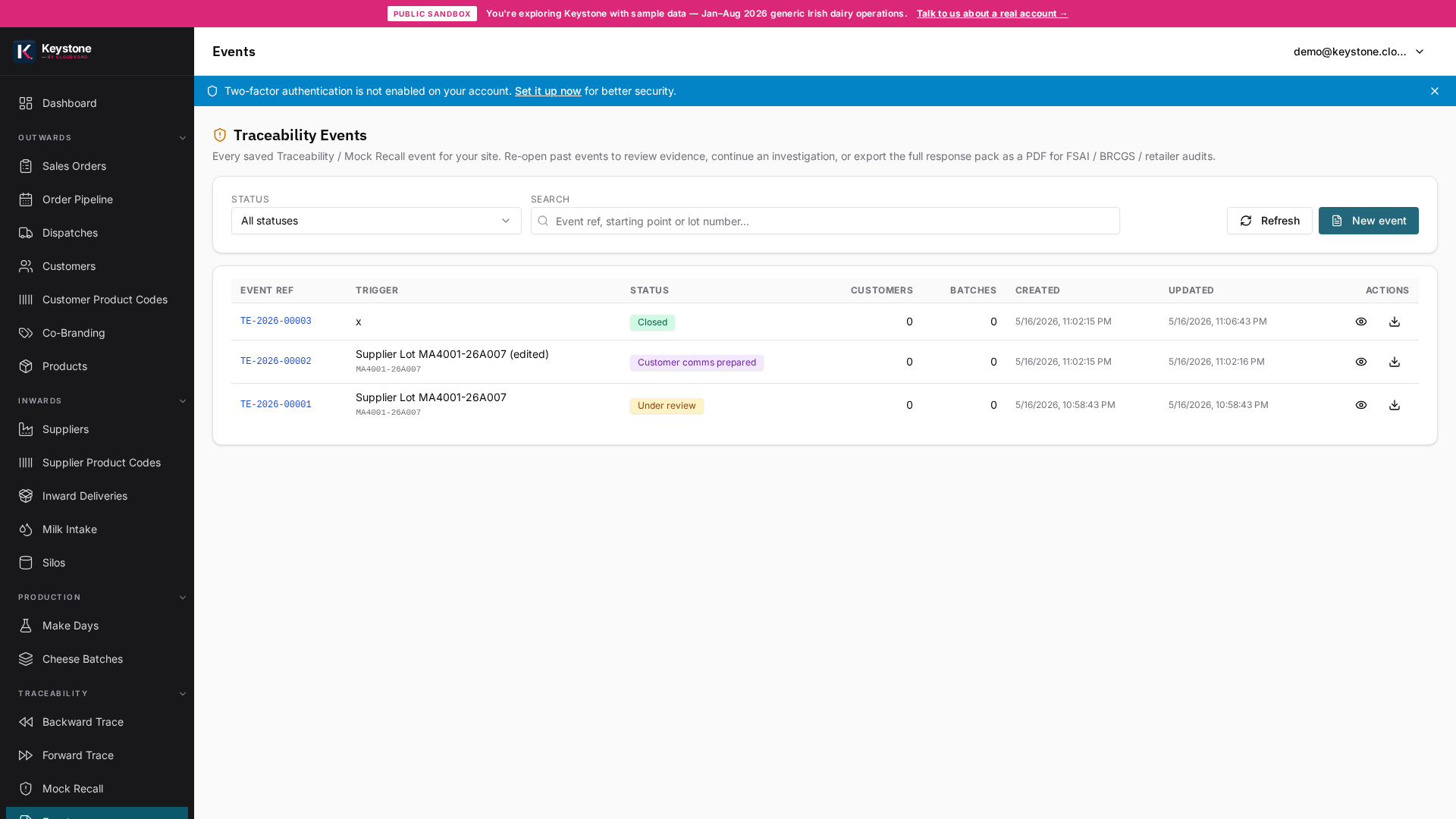
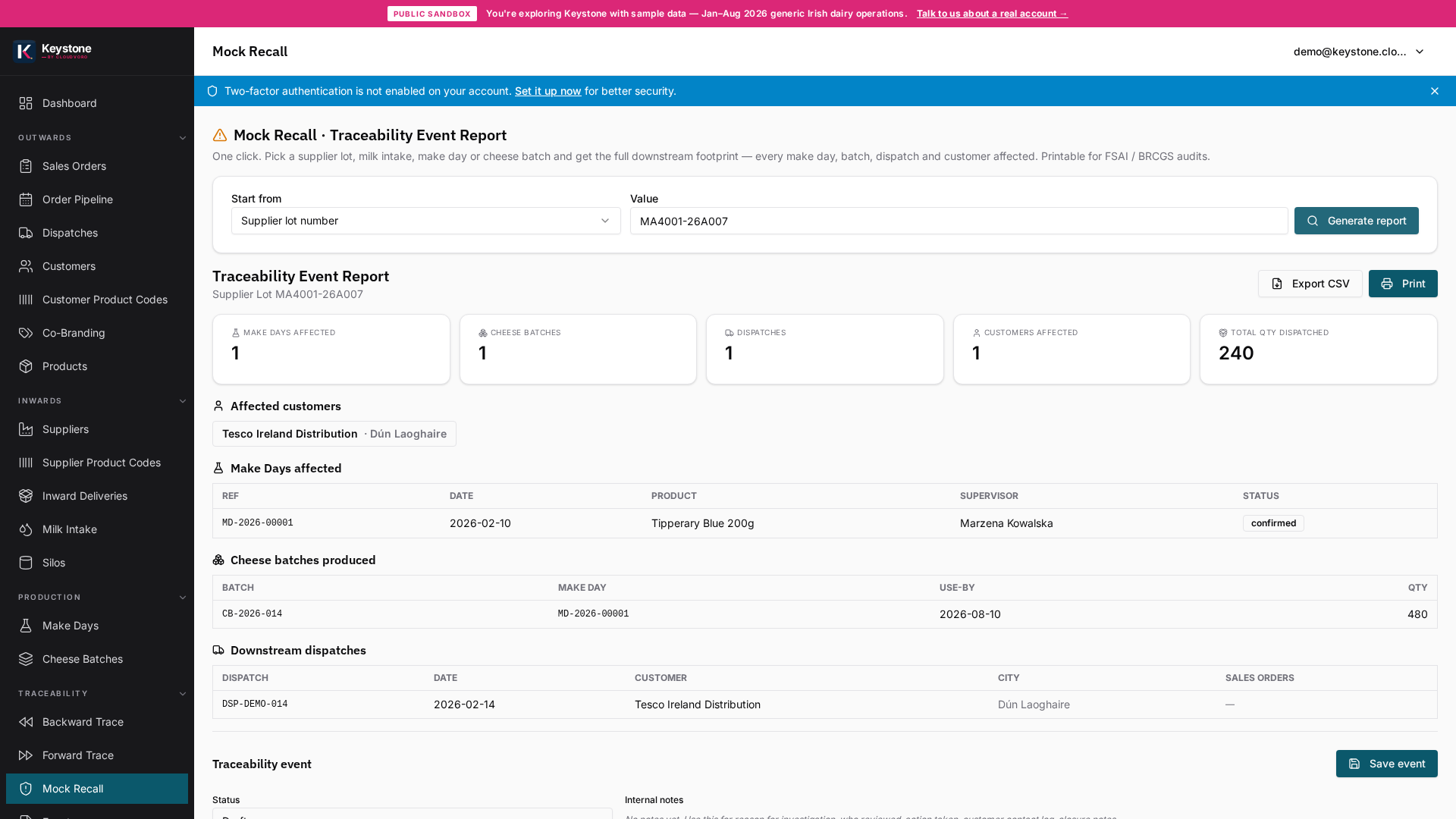
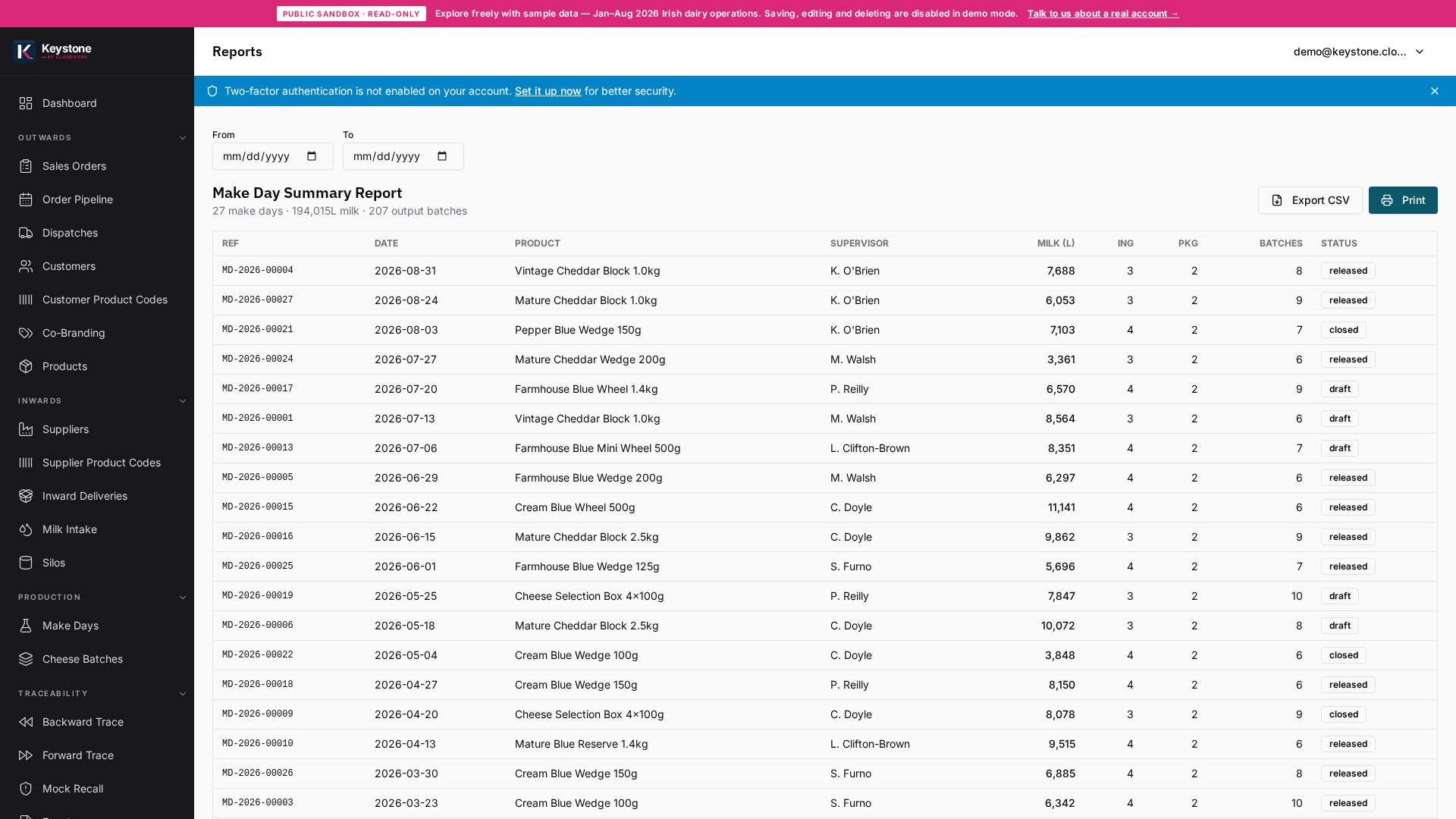
Nicht in der Küche, sondern in der Dokumentationslücke.
Der klassische Fall nicht deklarierter Allergene ist kein vereinzelter Fremdstoff; es ist schleichende Drift. Ein Lieferant reformuliert und die neue Spezifikation enthält Senf. Eine Rezeptur ändert sich, aber das Etikett wird nicht angepasst. Auf der Produktionslinie erfolgt um 6 Uhr eine Substitution und niemand dokumentiert sie. Jeder dieser Fälle ist zuerst ein Dokumentationsproblem, bevor er ein Kennzeichnungsproblem wird. Die anschließende Untersuchung fragt genau das, was Ihre Aufzeichnungen oft nicht beantworten können: Welche Chargen wurden mit der neuen Spezifikation hergestellt, ab welchem Datum und wer hat sie erhalten? Keystone löst das strukturell: Zutatenchargen sind mit Lieferantenspezifikationen verknüpft, Chargen dokumentieren den tatsächlichen Verbrauch, und Spezifikationsänderungen sind versioniert und mit Wirksamkeitsdaten versehen.
Allergenkontrolle als Aufzeichnung, nicht als bloße Wachsamkeit.
Nachweis-Engine, keine Artwork-Verwaltung.
Keystone ist die Aufzeichnungsschicht: welche Inhaltsstoffe jede Charge enthielt und wohin sie ging. Es erzeugt keine Etiketten-Artworks und nimmt Ihnen nicht die rechtliche Validierung Ihrer Deklarationen ab – Ihr Kennzeichnungsprozess und die technische Freigabe bleiben bei Ihnen. Was es beseitigt, ist die erschreckende Frage jeder Allergenuntersuchung: „Können wir nachweisen, was tatsächlich drin war?“ Hersteller von Fertigprodukten, Backwaren und Milchprodukten spüren das am stärksten; das Modell des Chargenverbrauchs ist bei allen gleich.
Related pages on this stack.
Fragen, die Einkäufer tatsächlich stellen.
Erstellt Keystone Allergen-Etiketten?
Was passiert, wenn ein Lieferant die Rezeptur ändert?
Kann es Allergenwarnungen über Zwischenprodukte nachverfolgen?
Hilft das bei einem BRCGS- oder Händleraudit?
Wie verhält es sich mit Kreuzkontamination / ‚kann Spuren enthalten‘?
Bereit herauszufinden, ob Keystone zu Ihrer Produktion passt?
20‑minütiges Kennenlerngespräch. Kein Verkaufsgespräch. Schriftlicher Leistungsumfang innerhalb von 48 Stunden, falls wir zueinander passen; andernfalls Empfehlung an einen geeigneteren Anbieter.
Kontaktieren Sie uns